








What's Happening?
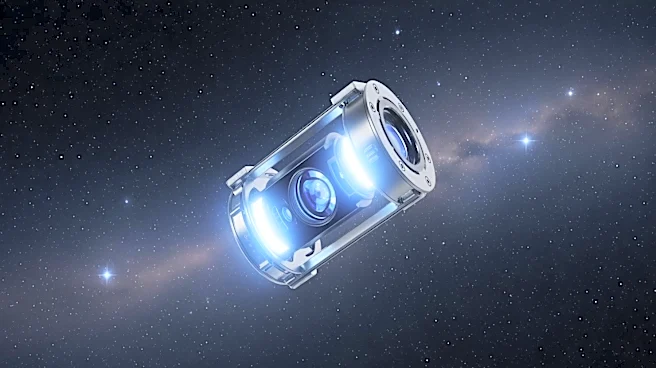
NASA's star tracker technology plays a crucial role in satellite navigation, allowing spacecraft to maintain precise orientation in space. This system uses high-precision cameras to capture images of star patterns, which are then compared against an onboard
celestial database to determine the spacecraft's exact attitude and orientation. This technology ensures that satellites can keep their antennas pointed at Earth, solar panels facing the sun, and scientific instruments locked onto their targets. A notable example of this technology's success is the Cassini mission to Saturn, where the spacecraft navigated through geysers on Enceladus, one of Saturn's moons, using star trackers. This system's accuracy is vital for the success of deep-space missions, as it allows spacecraft to perform complex maneuvers and maintain communication with Earth.
Why It's Important?
The star tracker technology is essential for the success of NASA's deep-space missions, as it provides the necessary precision for spacecraft navigation. This technology enables satellites to perform complex tasks, such as navigating through challenging environments like the geysers on Enceladus. The ability to maintain accurate orientation is crucial for the operation of scientific instruments and communication systems, which are vital for collecting data and sending it back to Earth. The success of missions like Cassini demonstrates the reliability and importance of star trackers in advancing our understanding of the universe. As NASA continues to explore deeper into space, the role of star tracker technology will become increasingly significant in ensuring mission success and safety.