




What's Happening?
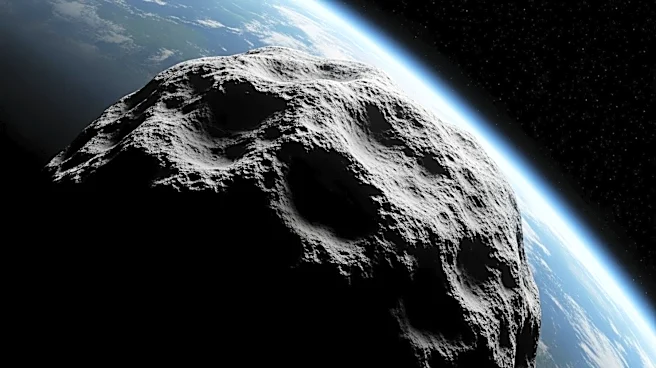
NASA has announced that an asteroid named Apophis, which is considered 'potentially hazardous,' will pass close to Earth on April 13, 2029. The asteroid, named after the ancient Egyptian god of chaos, will come within 20,000 miles of Earth, closer than
many geosynchronous satellites. Despite its alarming name, NASA assures that Apophis will safely pass by without posing any immediate threat. The asteroid, roughly the size of the Eiffel Tower, is composed of material from the early solar system. Discovered in 2004, Apophis has been closely monitored by scientists who initially projected potential impacts in 2029, 2036, or 2068. However, further studies have ruled out these possibilities. The close approach will allow scientists to study the asteroid's orbit and rotation changes due to Earth's gravitational pull.
Why It's Important?
The close passage of Apophis presents a rare opportunity for scientific study and public interest. Its proximity to Earth will allow researchers to observe gravitational effects on its orbit and rotation, providing insights into asteroid dynamics. This event underscores the importance of monitoring near-Earth objects, as understanding their trajectories can help mitigate potential future threats. The study of Apophis could also enhance our knowledge of the solar system's formation, as it is made of primordial material. For the public, the event highlights the capabilities of modern astronomy and the ongoing efforts to track and understand celestial bodies that could impact Earth.
What's Next?
NASA and other space agencies are preparing to study Apophis during its close approach. The OSIRIS-REx spacecraft and the European Space Agency's Rapid Apophis Mission for Space Safety (Ramses) are among the missions planned to gather data. Scientists aim to capture images and analyze the asteroid's physical characteristics and trajectory changes. This research could inform future planetary defense strategies and contribute to the broader understanding of asteroid behavior. Public interest is expected to grow as the date approaches, with educational and outreach activities likely to increase awareness of space science and planetary defense.