

What's Happening?
On June 30, 1908, a massive explosion occurred over the Podkamennaya Tunguska River in Siberia, flattening approximately 80 million trees over an area of 830 square miles. The explosion, which released energy equivalent to 10-15 megatons of TNT, was heard
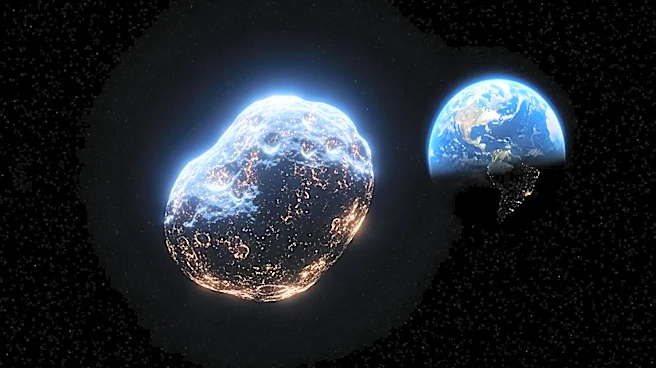
hundreds of miles away and caused atmospheric disturbances as far as Europe. Despite extensive investigations, the exact cause of the explosion remains a mystery. The leading theories suggest it was an airburst of a stony asteroid or a comet, but no definitive evidence has been found to confirm either hypothesis. The event is notable for its lack of a crater, as the object exploded in the air rather than impacting the ground.
Why It's Important?
The Tunguska event is significant as it highlights the potential threat posed by near-Earth objects. It serves as a reminder of the vulnerability of Earth to cosmic impacts, which could have catastrophic consequences if they occur over populated areas. The event has spurred scientific interest in planetary defense, leading to initiatives like NASA's Planetary Defense Coordination Office and the DART mission, which aim to develop strategies to deflect potentially hazardous asteroids. Understanding and preparing for such events is crucial for global safety and security.
What's Next?
While the Tunguska event remains partially unresolved, ongoing research and technological advancements continue to improve our ability to detect and mitigate the threat of near-Earth objects. International collaboration and investment in space observation and defense systems are likely to increase as awareness of these risks grows. Future missions may focus on further understanding the nature of such cosmic events and developing more effective response strategies.
Beyond the Headlines
The Tunguska event also raises questions about the limits of scientific understanding and the challenges of investigating historical natural phenomena. It underscores the importance of interdisciplinary research, combining geology, astronomy, and atmospheric science, to unravel complex mysteries. The event's legacy continues to influence scientific inquiry and public policy regarding space hazards.