




What's Happening?
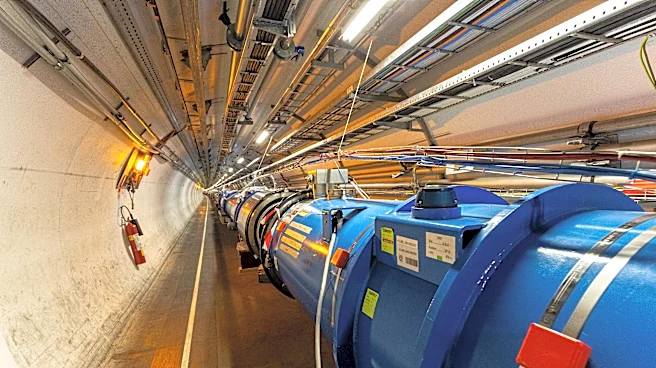
Scientists at the Large Hadron Collider (LHC) have found evidence that quark-gluon plasma (QGP), a state of matter believed to have existed moments after the Big Bang, can be created in surprisingly small collisions. This discovery emerged from experiments
involving oxygen and neon nuclei collisions, challenging the long-held assumption that only collisions of very heavy atomic nuclei, like lead, could generate the extreme conditions necessary for QGP formation. All four major LHC research collaborations—ALICE, ATLAS, CMS, and LHCb—have reported signs of this primordial matter. The findings indicate that the forces required to create QGP are not as enormous as previously thought, opening new avenues for investigating the universe's earliest moments. Researchers observed phenomena such as parton energy loss, where energetic quarks and gluons lose energy as they travel through the plasma, and suppression of certain energetic particles, consistent with QGP formation in lighter nuclei collisions. These observations were made by analyzing particle jets, charged particle production, and the behavior of exotic subatomic particles like upsilon mesons.
Why It's Important?
This breakthrough significantly alters the understanding of the conditions required to produce one of the most extreme states of matter known to physics. By demonstrating that QGP can form in smaller systems, scientists gain new, more accessible opportunities to study matter under extraordinary conditions that mimic the early universe. This could lead to a deeper comprehension of fundamental physics, including the forces that governed the universe's initial expansion and the properties of matter at its most basic level. The ability to recreate these conditions with lighter nuclei means experiments might become more frequent or less resource-intensive, accelerating research in particle physics. Furthermore, the findings could refine theoretical models of the Big Bang and the evolution of the cosmos, potentially resolving discrepancies or opening new lines of inquiry into dark matter and the matter-antimatter asymmetry.
What's Next?
Scientists will continue to analyze data from collisions involving lighter atomic nuclei to gather more evidence on how quark-gluon plasma forms and behaves. The ongoing upgrades to the Large Hadron Collider, transforming it into the High-Luminosity LHC, will enable researchers to collect substantially more collision data. This increased data volume will allow for more detailed investigations into the properties of QGP. Future experiments will likely focus on refining measurements of parton energy loss, particle suppression, and the behavior of exotic particles in these smaller collision systems. The goal is to build a clearer picture of the primordial plasma that dominated the universe shortly after its birth, potentially leading to new discoveries about the fundamental laws of physics.
Beyond the Headlines
The implications of this discovery extend beyond immediate particle physics research. The ability to study QGP in smaller, potentially more controllable environments could foster new theoretical frameworks that bridge quantum chromodynamics with cosmology. It might also inspire novel experimental techniques for probing extreme states of matter in other contexts. Philosophically, this research pushes the boundaries of human understanding regarding the universe's origins, offering a more nuanced view of the conditions that allowed for the formation of everything we observe today. The ongoing quest to understand the 'zeptoverse' and the fundamental building blocks of matter is a testament to scientific curiosity, continually refining our cosmic narrative.