







What's Happening?
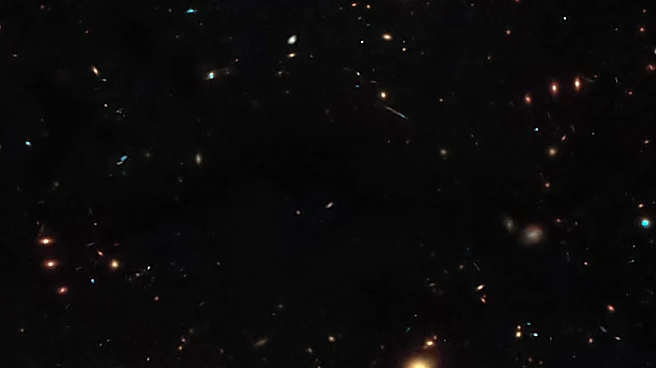
The eROSITA telescope, part of the Spektrum-RG mission, has released its second major data set, revealing nearly two million X-ray sources. Among these, the galaxy cluster A3266 has been studied for its unique characteristics. Researchers from Bonn's
Argelander Institute, led by Thomas Reiprich and Jakob Dietl, have measured the faint X-ray glow in the cluster's outer regions for the first time. The findings show that the gas in these outskirts is hotter and denser than current models predict, with a lower concentration of heavy elements. This suggests the presence of relatively pristine material from the cosmic web, challenging existing theories about cosmic structure formation.
Why It's Important?
The discovery of unexpected characteristics in the A3266 cluster's outskirts has significant implications for our understanding of cosmic structure formation. The findings challenge current models, suggesting that the processes of gas heating and mixing in galaxy clusters are more complex than previously thought. This research could lead to revisions in our understanding of how matter accumulates in the universe and the role of pristine material in cosmic evolution. The eROSITA data provides a valuable resource for astronomers, offering insights into the large-scale structure of the universe and the dynamics of galaxy clusters.
What's Next?
Further analysis of the eROSITA data will be crucial to refining models of cosmic structure formation. Researchers will continue to study the characteristics of galaxy clusters and their outskirts to better understand the processes at play. The findings may prompt new theoretical developments and simulations to account for the observed discrepancies. As eROSITA remains in safe mode, the scientific community will advocate for its return to operations to continue its valuable contributions to X-ray astronomy. Collaboration with other observatories and missions will also be essential to build a comprehensive picture of the universe's structure.