







What's Happening?
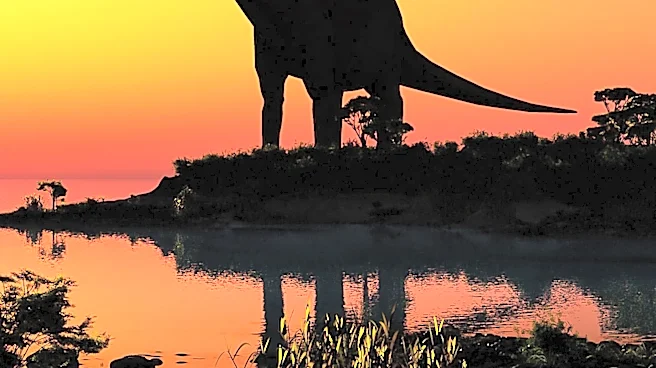
New research suggests that the asteroid impact that led to the extinction of the dinosaurs also created an environment conducive to the development of underground life. The Chicxulub crater in Mexico, formed by the asteroid impact 66 million years ago,
hosted a hydrothermal system that persisted for millions of years longer than previously thought. This system, created by the intense heat and fractured rocks interacting with seawater, provided ideal conditions for microorganisms. The study, published in Communications Earth & Environment, indicates that this hydrothermal system lasted for at least 8 million years, making it the longest-lasting asteroid-impact hydrothermal system documented to date. The findings offer insights into how life may have first emerged in such environments and could guide the search for life on other planets.
Why It's Important?
The research provides a new perspective on the origins of life on Earth, suggesting that asteroid impacts could create long-lasting environments suitable for life. This has implications for understanding the conditions necessary for life to develop and thrive. The study also highlights the potential for similar hydrothermal systems to exist on other planets, such as Mars, where impacts have been frequent. This could inform future space exploration missions in the search for extraterrestrial life. The findings underscore the importance of studying impact craters as potential sites for life, both on Earth and beyond.
What's Next?
The research team plans to continue studying the Chicxulub crater and other impact sites to further understand the conditions that support life. Future missions to Mars and other planets may focus on exploring impact craters as potential habitats for life. The study's findings could also influence the design of experiments and missions aimed at detecting life on other planets, guiding the selection of landing sites and exploration targets.