



What's Happening?
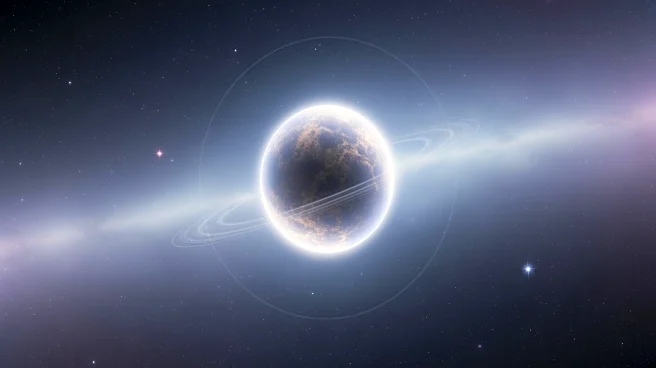
Astronomers have successfully measured the mass and distance of a free-floating planet, marking a significant milestone in the study of rogue planets. These planets, which do not orbit a star, are typically detected through gravitational microlensing,
a method that uses the planet's gravity to magnify the light of a distant star. The study, published in Science, details the observation of a microlensing event from both ground-based telescopes and the Gaia space telescope, allowing researchers to calculate the planet's distance at 9,785 light-years and its mass at approximately 22% of Jupiter's. This achievement overcomes the 'mass-distance degeneracy' that previously hindered precise measurements of such planets.
Why It's Important?
This discovery is crucial as it opens new avenues for understanding the formation and evolution of planetary systems. Rogue planets are believed to have been ejected from their original systems, and studying them can provide insights into the dynamics of planetary formation. The ability to measure both mass and distance accurately allows scientists to better understand the characteristics and origins of these planets. This breakthrough could lead to more discoveries, enhancing our knowledge of the universe and potentially identifying more rogue planets, which could have implications for theories about planetary system stability and evolution.
What's Next?
With the scheduled launch of the Nancy Grace Roman Space Telescope in 2027, astronomers anticipate the discovery of more rogue planets. This telescope will enhance the ability to detect and study these planets, potentially leading to a deeper understanding of their prevalence and characteristics. The continued development of microlensing techniques and space-based observations will likely yield further breakthroughs in the study of free-floating planets, contributing to the broader field of exoplanet research.