




What's Happening?
Physicist Stephan Schlamminger at the National Institute of Standards and Technology (NIST) has concluded a decade-long effort to precisely measure the universal gravitational constant, known as 'big G.' Despite meticulous experimentation and analysis,
his team's result of 6.67387 × 10^-11 meters^3/kilogram/second^2 is 0.0235% lower than a previous measurement conducted by the International Bureau of Weights and Measures (BIPM) in 2007. Schlamminger employed a 'blinded' experiment design, where a colleague, Patrick Abbott, scrambled part of the data by subtracting a secret number, to prevent unconscious bias. After nearly opening the sealed envelope containing the correction in 2022, Schlamminger delayed the reveal to account for subtle effects like air pressure. The final unveiling in July 2024 confirmed a significant discrepancy between the NIST and BIPM results, highlighting the persistent challenge in accurately determining this fundamental constant. The experiment utilized a torsion balance, a technique dating back to Henry Cavendish's 1798 experiment, and tested both copper and sapphire masses, yielding consistent results.
Why It's Important?
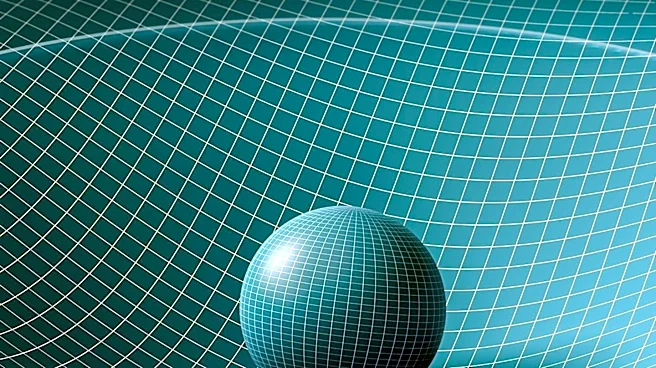
The persistent discrepancy in measuring 'big G' holds significant implications for fundamental physics and the U.S. scientific community. While the difference of 0.0235% may seem minor in everyday life, it is substantial in the realm of fundamental constants, which are typically known with much higher precision. This ongoing mismatch raises a critical question: is it due to overlooked experimental errors, or does it hint at a deeper, unknown aspect of gravity itself? Historically, small discrepancies have sometimes led to revolutionary scientific discoveries, suggesting that the current understanding of gravity might be incomplete. For the U.S., continued investment in precision measurements like those at NIST is crucial for advancing scientific knowledge and maintaining leadership in fundamental research. The inability to precisely pin down 'big G' impacts theoretical models of the universe, from the behavior of celestial bodies to the very fabric of spacetime, and could influence future technological developments that rely on a complete understanding of physical laws.
What's Next?
The ongoing disagreement over the value of 'big G' is likely to spur further research and experimentation within the U.S. and international scientific communities. Other research teams will likely attempt to replicate these experiments or devise new methodologies to resolve the discrepancy. This could involve developing even more sensitive instruments, exploring different experimental environments, or re-evaluating theoretical assumptions about gravity. The scientific community will continue to scrutinize the methodologies of both the NIST and BIPM experiments to identify any potential sources of systematic error. While Schlamminger has indicated he will pass the torch to younger generations, the challenge remains for physicists to converge on a universally accepted value for 'big G.' This pursuit will contribute to a deeper understanding of one of the universe's most fundamental forces and could potentially lead to breakthroughs in physics.
Beyond the Headlines
The quest to precisely measure 'big G' transcends a mere numerical value; it delves into the philosophical underpinnings of scientific inquiry and the nature of reality. The fact that gravity, one of the most familiar forces, remains so elusive in precise measurement highlights the limitations of current scientific methods or, more intriguingly, the possibility of unknown physics. This situation underscores the scientific principle that even seemingly small discrepancies can hold profound implications, challenging established paradigms. The 'blinded' experimental design employed by Schlamminger also speaks to the rigorous ethical and methodological standards in scientific research, aiming to eliminate human bias in the pursuit of objective truth. The continued inability to reconcile 'big G' measurements could inspire new theoretical frameworks or experimental approaches, potentially leading to a paradigm shift in how gravity is understood, much like past discoveries that emerged from similar scientific puzzles. It serves as a powerful reminder that even in an age of advanced technology, fundamental questions about the universe persist.