





What's Happening?
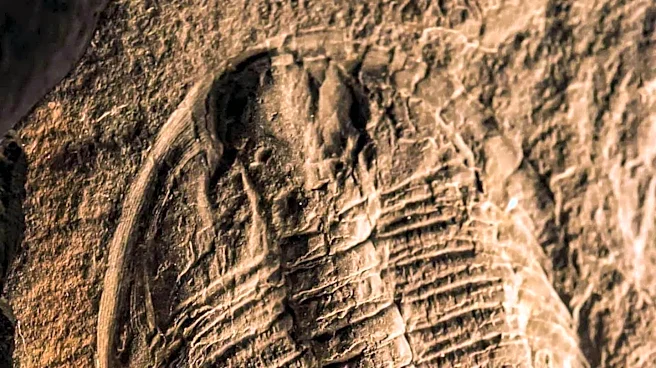
A recent study led by Andrea Baucon, published in Earth-Science Reviews, proposes that arthropods, possibly crustaceans, were the architects of the 500-million-year-old hexagonal tunnel systems known as 'paleodictyon.' These intricate networks, first
appearing in the early Cambrian period, have puzzled paleontologists for over 170 years due to their geometric precision and persistence across geological eras, with modern examples still forming on the seafloor. Previous theories often attributed these structures to worm-like creatures. The research team examined fossil specimens from Italy, Portugal, and Poland, spanning various geological periods. Utilizing high-resolution photography and 3D modeling, they meticulously measured the tunnels' widths, lengths, and angles. Their findings revealed consistent branching at approximately 120 degrees, characteristic of a perfect hexagon, with straight walls and sharp corners. This geometric consistency and the implied spatial awareness required for such construction led researchers to conclude that arthropods, known for their ability to scrape and relocate sediment, are a more plausible builder than soft-bodied worms, which typically create winding, rounded burrows.
Why It's Important?
This re-evaluation of the 'paleodictyon' builder significantly impacts our understanding of ancient marine ecosystems and the evolutionary capabilities of early life forms. If arthropods were indeed responsible for these complex structures, it suggests a higher level of behavioral sophistication and spatial awareness in these creatures much earlier in evolutionary history than previously assumed. This challenges long-held paleontological theories and could lead to a broader reassessment of the cognitive and engineering abilities of Cambrian-era organisms. The persistence of these structures from the Cambrian period to the present day also highlights the remarkable evolutionary success and adaptability of the unknown builder, whether it be an arthropod or another organism. Understanding the true nature of the 'paleodictyon' builder can provide crucial insights into the development of complex behaviors and ecological interactions in deep-sea environments over vast geological timescales, influencing how scientists interpret trace fossils and ancient marine life.
What's Next?
To definitively identify the builder of the 'paleodictyon' tunnels, researchers are proposing deep-sea monitoring initiatives. These efforts would involve using autonomous time-lapse imaging, environmental DNA sampling, and sediment profile imaging at locations where these hexagonal networks are actively forming. The goal is to directly observe the organism responsible for creating these structures in real-time. Such direct observation would provide irrefutable evidence, closing the gap between circumstantial evidence and definitive identification. Success in these monitoring efforts could lead to the discovery of a previously unobserved or unidentified deep-sea species, or confirm the involvement of known arthropod groups. This would not only solve a long-standing paleontological mystery but also open new avenues for studying the behavior and ecology of deep-sea organisms, potentially revealing novel biological mechanisms for constructing complex geometric structures in challenging environments.
Beyond the Headlines
The mystery of the 'paleodictyon' tunnels extends beyond mere identification of the builder; it delves into the fundamental questions of biological engineering and communication in ancient and modern marine environments. The study's suggestion that these networks might have served as a signaling system for colonial organisms, transmitting acoustic, hydraulic, or chemical cues, opens up fascinating possibilities about early forms of inter-organism communication. This could imply a level of social organization or cooperative behavior in ancient arthropods that is not commonly attributed to such early life forms. Furthermore, the geometric precision of these tunnels, consistently branching at 120-degree angles, raises questions about the underlying biological or physical principles that guide such construction. It highlights the potential for natural selection to favor highly efficient and geometrically optimized structures, even in the absence of direct visual observation of the builder. This ongoing enigma underscores the vast unknowns that still exist in our understanding of Earth's deep past and the complex life forms that inhabited it.