
What's Happening?
Scientists have discovered a vast hidden geological feature beneath the East Antarctic Ice Sheet, revealing a previously unrecognized connection between some of the continent's largest buried landscapes.
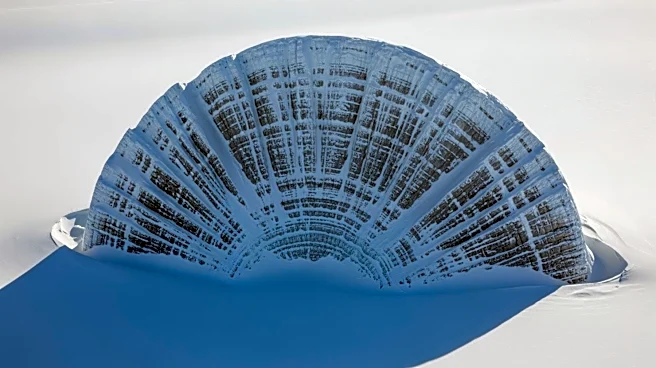
This newly identified structure consists of a network of enormous basins concealed beneath ice that exceeds three kilometers in thickness in some areas. Named the East Antarctic Fan-shaped Basin Province, it includes well-known subglacial features such as the Wilkes and Aurora basins, and the basin containing Lake Vostok, the largest known subglacial lake on Earth. The structure likely formed through a process called distributed rotational extension, where continental crust stretches outward from a central point. This discovery, led by Dr. Egidio Armadillo of the University of Genoa, was supported by the Italian National Antarctic Research Program.
Why It's Important?
The discovery of this massive geological structure is significant as it provides new insights into the geological history of Antarctica, particularly its role in the formation and evolution of the ancient Gondwana supercontinent. The structure's influence extends beyond historical reconstruction, as the shape of the bedrock beneath the ice affects how ice moves across the continent today. This hidden landscape determines the location of subglacial basins and lakes, potentially impacting the stability of regions of the Antarctic Ice Sheet vulnerable to climate change. Understanding these dynamics is crucial for predicting future changes in ice movement and sea level rise, which have global implications.
What's Next?
Future research will likely focus on understanding the geodynamic processes responsible for the formation of this structure and its implications for the stability of the Antarctic Ice Sheet. Scientists may conduct further studies to map the subglacial topography and analyze the tectonic history of the region. These efforts could provide valuable data for climate models, helping to predict the impact of climate change on ice sheet dynamics and global sea levels. Additionally, international collaboration may be necessary to explore the broader implications of this discovery for understanding Earth's geological history.