






What's Happening?
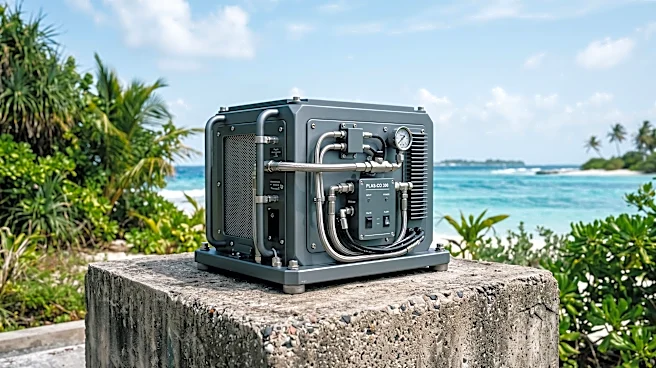
An innovative solution, dubbed 'lightning in a box,' is being deployed in the Maldives to convert untreated sewage into fertilizer, aiming to protect fragile coral reefs and enhance food security. This compact plasma unit, currently en route from Norway,
is expected to arrive in December for a trial on the Maldivian island of Thoddoo. The five-year project is implemented by the United Nations Environment Programme (UNEP), supported by the Global Environment Facility (GEF), and led by Maldives National University and the UK Centre for Ecology & Hydrology. The technology, which mimics the natural process of lightning converting atmospheric nitrogen, will be tested on human sewage for the first time in a real-world setting. The goal is to assess the safety of the treated liquid and its effectiveness as a fertilizer for crops, while simultaneously reducing ocean pollution caused by untreated sewage discharge.
Why It's Important?
This project holds significant importance for global environmental efforts, including potential implications for U.S. coastal communities and environmental policy. The successful implementation of this sewage-to-fertilizer technology could offer a scalable model for small island developing states and other coastal regions grappling with wastewater management and marine pollution. For the U.S., which has extensive coastlines and faces similar challenges in protecting marine ecosystems, this innovation could inspire new approaches to wastewater treatment and resource recovery. It demonstrates a practical application of technology to address multiple environmental issues—pollution, food security, and climate resilience—simultaneously. U.S. companies in environmental technology and sustainable agriculture could find opportunities for collaboration or adaptation of similar solutions.
What's Next?
Upon its arrival in December, the plasma unit will undergo trials on Thoddoo to evaluate its performance in treating human sewage and producing safe, effective fertilizer. If these initial trials prove successful, a second phase is planned to expand the system and establish a piped network to deliver the treated liquid directly to farmers' fields. The project aims to position the Maldives as a regional leader in demonstrating how island nations can eliminate marine sewage dumping while simultaneously enhancing food security and climate resilience. The outcomes of this trial will be closely watched by international environmental organizations and governments, potentially influencing future investments and policies in wastewater management and marine conservation globally.
Beyond the Headlines
The 'lightning in a box' technology represents a paradigm shift in how waste is perceived, transforming it from a pollutant into a valuable resource. This approach aligns with the principles of a circular economy, where waste is minimized, and resources are reused. Beyond its immediate environmental benefits, the project addresses critical issues of food security in vulnerable island nations by reducing reliance on imported fertilizers and enhancing local agricultural production. The successful demonstration of this technology could foster greater innovation in waste-to-resource solutions worldwide, potentially leading to a broader adoption of such sustainable practices in various sectors, including those in the U.S., and contributing to a more resilient and self-sufficient global food system.