


What's Happening?
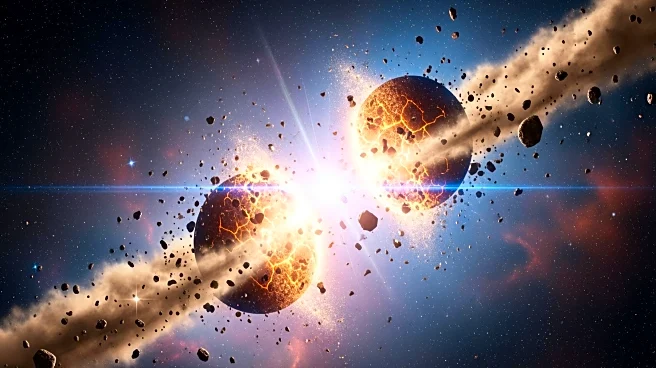
Astronomers have observed two rare and significant collisions in the Fomalhaut star system, located 25 light-years away in the constellation Piscis Austrinus. These events involved the collision of planetesimals, which are rocky building blocks of planets,
resulting in massive clouds of debris. The Fomalhaut system, often referred to as the 'Eye of Sauron' due to its distinctive dust belt, has been a subject of interest for its resemblance to early solar system conditions. The recent observations were made by an international team led by Paul Kalas from the University of California, Berkeley. The team noted that these collisions, named Fomalhaut cs1 and cs2, are particularly rare, with such events expected to occur only once every 100,000 years. However, the Fomalhaut system experienced two such collisions within just 20 years, providing a unique opportunity to study the dynamics of planetary formation.
Why It's Important?
The observations of these collisions offer valuable insights into the processes of planetary formation and the conditions of early solar systems. The Fomalhaut system's dust belt, formed from countless rocky and icy collisions, serves as an analog to our own solar system's early days. Understanding these events helps scientists reconstruct the history of planetary systems and the frequency of such collisions. The study also highlights the challenges in identifying exoplanets, as the debris clouds from these collisions can mimic the appearance of planets. This research is crucial for improving the accuracy of exoplanet detection and understanding the mechanics of debris belts, which are essential for the formation of planets.
What's Next?
Future research will likely focus on further analyzing the Fomalhaut system to identify any hidden influences, such as unseen exoplanets, that may be affecting the timing and location of these collisions. The study suggests a 10% chance that the observed collisions are not random, indicating the potential presence of a gravitational influence. Additionally, next-generation observatories, like NASA's Habitable Worlds Observatory, will benefit from these findings by refining techniques for distinguishing between planets and other celestial objects. Continued observation of the Fomalhaut system could provide more data on the frequency and impact of such collisions, enhancing our understanding of planetary system evolution.