
What's Happening?
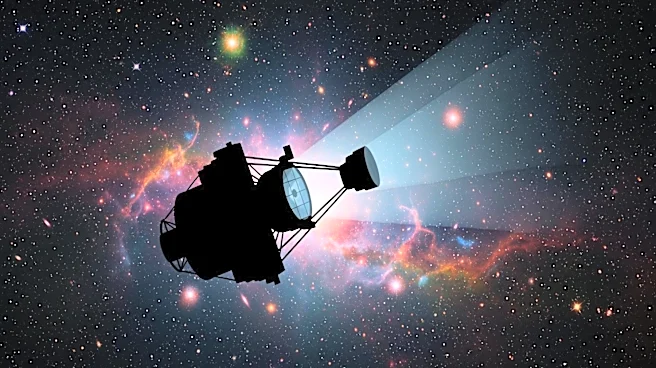
A space telescope has identified a peculiar pattern in cosmic rays, potentially solving a longstanding astronomical mystery. Using data from the DAMPE (Dark Matter Particle Explorer) space telescope, researchers
discovered a consistent pattern among various high-energy cosmic particles. This finding, published in Nature, suggests a universal principle governing cosmic ray behavior. Cosmic rays, which are charged particles traveling at high energies, are believed to originate from violent astrophysical events like supernovae and black hole jets. The DAMPE data revealed a phenomenon known as spectral softening, where the number of detected particles drops sharply after a certain energy threshold. This pattern was observed across different particles, from protons to iron nuclei, indicating a possible common rule for cosmic ray behavior.
Why It's Important?
The discovery of a universal pattern in cosmic rays is significant as it narrows down the mechanisms of how these particles gain energy and travel through space. This finding challenges existing models of particle acceleration in extreme environments, providing new insights into the role of magnetic fields and shock waves. The research supports the rigidity theory, suggesting that cosmic rays are influenced more by their rigidity than by energy per nucleon. This breakthrough could lead to a better understanding of cosmic phenomena and improve models predicting cosmic ray behavior, impacting fields like astrophysics and space exploration.
What's Next?
Future research will likely focus on further analyzing the DAMPE data to refine the understanding of cosmic ray acceleration and transport. Scientists may also explore the implications of the rigidity theory in other cosmic phenomena. The use of artificial intelligence in analyzing particle events could be expanded to enhance data interpretation. Additionally, the findings may prompt the development of new instruments or missions to study cosmic rays and their origins more comprehensively.
Beyond the Headlines
The discovery highlights the potential of international collaborations and advanced technologies in solving complex scientific mysteries. The use of AI in this research underscores its growing importance in data analysis and scientific discovery. The findings may also influence educational and research priorities in astrophysics, encouraging a focus on cosmic ray studies and the development of related technologies.