



What's Happening?
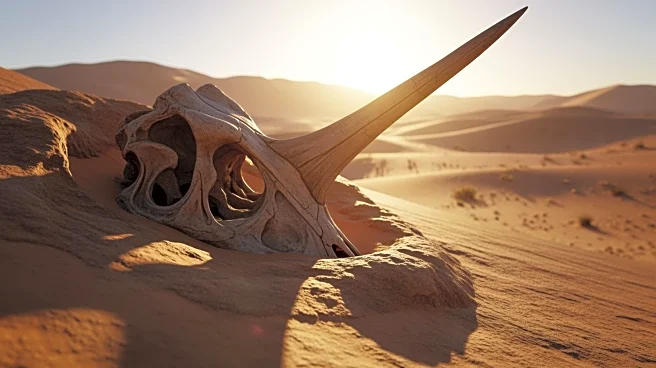
A new species of Spinosaurus, named S. mirabilis, has been discovered in the central Sahara, surprising paleontologists due to its location far from ancient shorelines. The fossil, first found in 2019, was unearthed in Niger, approximately 600 miles from the ancient coastline,
challenging the previous belief that spinosaurids were fully aquatic. The discovery was made by a team led by Paul Sereno from the University of Chicago. The S. mirabilis is noted for its scimitar-shaped crest and interlocking teeth, suggesting it was adept at catching fish. The find was significant enough to be featured on the cover of Science magazine, and a replica of the skull will be displayed at the Chicago Children's Museum.
Why It's Important?
The discovery of S. mirabilis in the Sahara has significant implications for understanding the habitat and behavior of spinosaurids. Previously thought to be fully aquatic, this find suggests that these dinosaurs may have been more versatile, capable of living in environments far from large bodies of water. This challenges existing theories about their ecological niche and could lead to a reevaluation of how these species adapted to their environments. The discovery also highlights the potential for significant paleontological finds in overlooked areas, encouraging further exploration and study.
What's Next?
Following this discovery, researchers may focus on further excavations in the Sahara and similar regions to uncover more about the lifestyle and adaptations of spinosaurids. The findings could prompt a reexamination of other spinosaurid fossils to determine if similar adaptations are present. Additionally, the public display of the S. mirabilis replica aims to inspire interest in paleontology and encourage the next generation of scientists to explore and preserve Earth's history.
Beyond the Headlines
The discovery of S. mirabilis not only challenges scientific assumptions but also underscores the importance of interdisciplinary collaboration in paleontology. The use of digital modeling and artistic reconstruction played a crucial role in understanding the new species. This approach may become more prevalent in future paleontological studies, offering new insights into ancient life forms. Furthermore, the involvement of local communities in the discovery process highlights the value of integrating indigenous knowledge with scientific research.