





What's Happening?
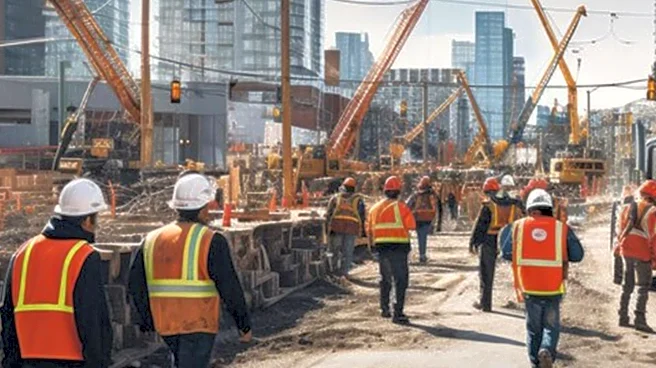
State and city leaders in Hawaii have initiated the redevelopment of the Mayor Wright Homes, marking the largest public housing project in the state's history. Located in the Kalihi-Palama neighborhood near downtown Honolulu, the 15-acre site will replace
the nearly 75-year-old complex with over 2,400 new rental homes across 10 towers. The project, a collaboration between the Hawaiʻi Public Housing Authority and developer Highridge Costa, aims to create mixed-income housing, with more than half of the units designated for tenants earning less than 80% of the area median income. Later phases will accommodate households earning up to 100% of the area median income. Current residents displaced by construction will be relocated and given priority to return. Governor Josh Green emphasized the project's centrality to the state's housing strategy, highlighting the link between stable housing and improved health, education, and food security.
Why It's Important?
This redevelopment is a significant step in addressing Hawaii's persistent housing crisis, aiming to provide modern, safe, and affordable homes for a diverse range of income levels. By increasing the housing stock sevenfold at this location, the project seeks to alleviate pressure on the state's housing market and reduce the concentration of poverty in public housing communities. The integration of commercial space and public parks within the development, along with its proximity to the planned Iwilei rail station, suggests a comprehensive approach to urban planning that could serve as a model for other U.S. cities facing similar challenges. The initiative also represents a substantial public-private partnership, with an estimated cost of $333 million for Phase 1A and a total project cost previously estimated at $1.3 billion, demonstrating a significant investment in community infrastructure and social welfare.
What's Next?
The first building of the Mayor Wright Homes redevelopment is scheduled to open in 2029, with the entire project expected to take 15 years to complete. Future phases will continue to expand the housing options, including condominiums for sale, further diversifying the community. The project's success will likely be closely monitored as a benchmark for large-scale public housing initiatives in the U.S., particularly regarding its mixed-income model and integration with public transit. Stakeholders, including the Hawaiʻi Public Housing Authority, Highridge Costa Development Company, and local government officials, will continue to oversee the construction and implementation, ensuring that the project meets its goals of providing equitable and sustainable housing solutions for Hawaii's residents.
Beyond the Headlines
The Mayor Wright Homes redevelopment transcends a simple construction project; it represents a philosophical shift in how public housing is conceived and executed in the U.S. By moving away from solely low-income housing to a mixed-income model, the project aims to de-stigmatize public housing and foster more integrated, resilient communities. The emphasis on 'housing provides health' by Governor Green underscores a growing recognition of housing as a fundamental determinant of well-being, impacting education, health care access, and economic stability. This holistic approach could influence future urban development policies, promoting the creation of vibrant, inclusive neighborhoods rather than isolated enclaves of poverty. The long-term success of this project could offer valuable lessons for addressing systemic inequalities and promoting social mobility through thoughtful urban planning and housing policy.