
What's Happening?
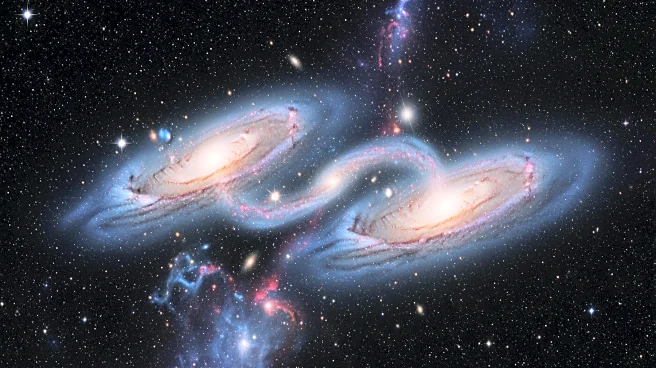
The European Space Agency's Euclid Space Telescope has captured a striking image of a galaxy merger, showcasing a languid spiral galaxy against the backdrop of deep space. Launched in 2023, Euclid is on
a six-year mission to map the cosmos, aiming to observe billions of galaxies and provide insights into the formation and evolution of galaxies. The telescope's observations are expected to shed light on dark matter and dark energy, which influence the expansion of the universe. The recent image features the galaxy NGC 646, located 392 million light-years from Earth, and highlights the telescope's capability to capture detailed cosmic phenomena.
Why It's Important?
The Euclid Space Telescope's mission is crucial for advancing our understanding of the universe. By mapping galaxies and studying dark matter and dark energy, Euclid aims to answer fundamental questions about the universe's structure and expansion. The data collected will help scientists understand how galaxies form and evolve over billions of years. This research is vital for cosmology and astrophysics, as it provides insights into the forces shaping the universe. The telescope's findings could lead to breakthroughs in our understanding of dark matter and dark energy, which remain some of the most mysterious aspects of the cosmos.
What's Next?
Euclid's mission will continue as it releases its first formal batch of data next year, covering about 14% of its final survey area. This data will be crucial for scientists studying the universe's expansion and the role of dark matter and dark energy. The telescope will continue to capture images and data from distant galaxies, contributing to a comprehensive map of the cosmos. As Euclid's mission progresses, it is expected to provide valuable insights that will enhance our understanding of the universe and its underlying forces.