





What's Happening?
A recent study conducted by researchers at Eötvös Loránd University in Budapest has provided new insights into the organization of neurons and their potential role in consciousness. By mapping the connectome of the fruit fly, the study utilized hyperbolic
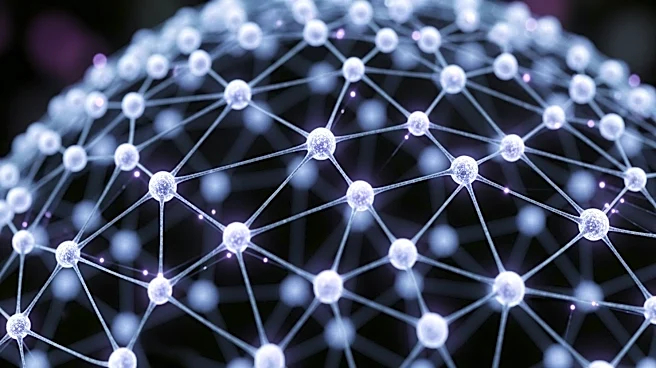
geometry to reveal hidden patterns in neuronal connections. This approach allowed researchers to observe how neurons that serve as major communication hubs cluster near the center, while more specialized cells drift toward the edge. The study suggests that this hidden geometry might reflect fundamental aspects of how brains organize themselves, potentially offering new perspectives on consciousness.
Why It's Important?
The findings of this study could have significant implications for neuroscience and our understanding of consciousness. By using hyperbolic geometry, researchers have uncovered a new way to visualize and understand the complex networks within the brain. This could lead to advancements in how we study brain function and disorders, potentially impacting fields such as artificial intelligence and neurotechnology. The study also raises questions about whether similar patterns exist in the human brain, which could revolutionize our approach to studying consciousness and cognitive processes.
What's Next?
Future research may focus on applying these findings to human brain studies to determine if similar organizational patterns exist. This could involve developing new tools and methods for mapping human neuronal networks using hyperbolic geometry. Additionally, the study's implications for understanding consciousness may prompt further exploration into the connections between neuronal organization and cognitive functions. Researchers may also investigate how these findings can be applied to improve treatments for neurological disorders.
Beyond the Headlines
The study challenges traditional views of brain mapping by suggesting that the brain's organization may be more complex than previously thought. This could lead to a shift in how neuroscientists approach the study of brain function, moving away from focusing solely on anatomical structures to considering the dynamic interactions between neurons. The use of hyperbolic geometry as a tool for understanding brain networks may also inspire new interdisciplinary collaborations between mathematicians and neuroscientists.