





What's Happening?
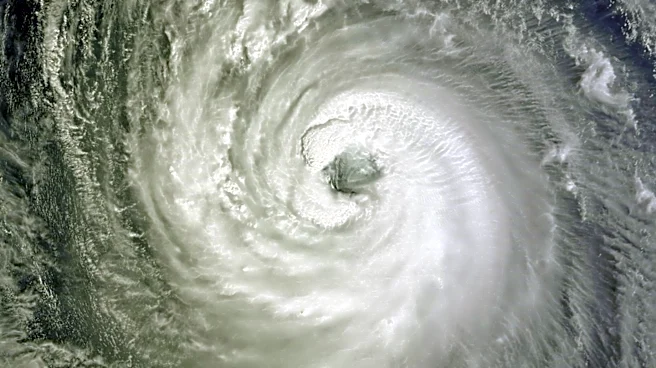
The World Meteorological Organization (WMO) is collaborating with weather services to expand the use of probabilistic tropical cyclone forecasting, aiming to improve early warnings and disaster preparedness. This approach provides a range of possible
scenarios rather than a single outcome, helping local governments understand potential impacts and make informed decisions. Despite the availability of sophisticated probabilistic products, a WMO survey revealed that only 43% of countries use them operationally, highlighting the need for better training and communication. The initiative seeks to bridge the gap between forecast information and local decision-making, ensuring that communities are better prepared for tropical cyclones.
Why It's Important?
Probabilistic forecasting is crucial for enhancing disaster preparedness and reducing the impacts of tropical cyclones. By providing a range of possible scenarios, this approach allows emergency managers and forecasters to make more informed decisions, ultimately leading to better protection for communities at risk. The initiative emphasizes the importance of training and communication to ensure that probabilistic forecasts are effectively utilized. As AI-based weather models continue to advance, the integration of probabilistic forecasting will become increasingly important for improving the accuracy and reliability of cyclone predictions.
What's Next?
The WMO workshop on tropical cyclone probabilistic forecasting attracted nearly 700 participants from over 80 countries, highlighting the global interest in improving cyclone preparedness. The focus will be on providing hands-on training, multilingual e-learning, and peer-to-peer mentoring to enhance the use of probabilistic forecasts. As AI technology continues to evolve, forecasters will need to evaluate model outputs and translate uncertainty into actionable guidance. The initiative aims to ensure that probabilistic forecasting reaches the forecasters, emergency managers, and communities who need it most before the next storm arrives.