


What's Happening?
The regulation of artificial intelligence (AI) in the United States is currently a contentious issue, with debates centering on whether it should be managed at the federal level or left to individual states. As of now, 27 states have enacted a total of 73
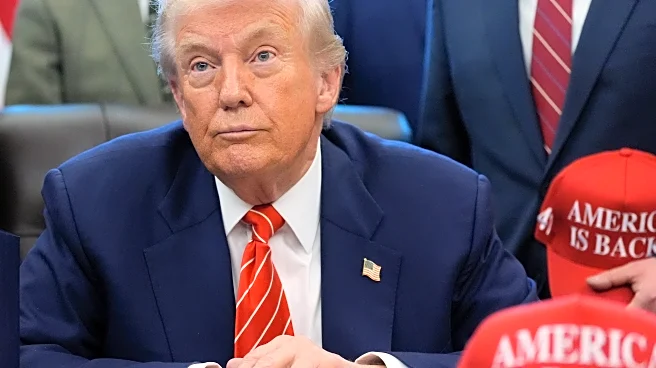
laws addressing various aspects of AI, including protections against deepfakes, AI use in healthcare and education, and government use in law enforcement. These state laws also require AI companies to disclose risks and how they are addressing them. The Trump administration is advocating for federal preemption of state regulations, arguing that a fragmented regulatory landscape could hinder AI development and the U.S.'s global leadership in the field. This position is set to be formalized in an upcoming executive order. Meanwhile, there is no unified stance from the Democratic Party on AI regulation, and within MAGA circles, there is a push for more stringent regulation, contrasting with the administration's laissez-faire approach.
Why It's Important?
The outcome of this regulatory debate has significant implications for the U.S. AI industry and its global competitiveness. Federal regulation could provide uniform standards, reducing compliance costs and fostering innovation, which is crucial for maintaining the U.S.'s edge over international competitors like China. However, state-level regulations allow for more tailored approaches to local issues, such as safeguarding children from AI-related risks. The decision on whether to centralize AI regulation will affect not only the industry's growth but also consumer protection and safety. A federal approach could streamline operations for AI companies, but it might also overlook specific regional concerns that state regulations are better equipped to address.
What's Next?
The Trump administration's forthcoming executive order will likely intensify lobbying efforts from both sides of the debate. A $100 million super PAC, Leading the Future, is already mobilizing against state-by-state regulation. Meanwhile, governors from both parties are expected to advocate for maintaining state regulatory authority, arguing that they are more attuned to local issues. The challenge will be to forge a bipartisan agreement that balances federal oversight with state flexibility, similar to the compromise achieved in the 1984 Cable Communications Policy Act. This legislative effort will require significant negotiation and leadership to ensure that AI regulation supports both innovation and public safety.
Beyond the Headlines
The debate over AI regulation also touches on broader themes of federalism and the balance of power between state and federal governments. It raises questions about the role of government in regulating emerging technologies and the potential for regulatory frameworks to either stifle or stimulate innovation. The outcome could set a precedent for how other technologies are regulated in the future, influencing the U.S.'s ability to adapt to technological advancements while protecting its citizens.