








What's Happening?
Travelers venturing into rural areas of Japan, including mountainous regions, national parks, and remote islands, frequently encounter mobile signal gaps, according to a recent report. While Japan boasts some of the world's best mobile coverage, with
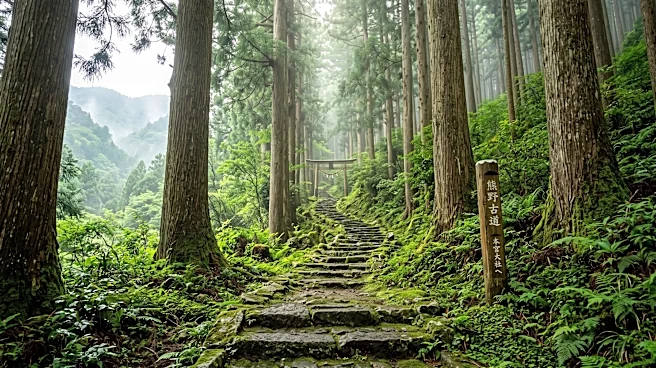
networks like KDDI's au covering over 99.9% of the population, this figure only accounts for approximately 60% of the country's geographic area. This disparity means that popular hiking routes such as the Kumano Kodo, located just hours from Osaka, can have no signal at all in forested mountain passes. Major Japanese operators like NTT Docomo, au (KDDI), SoftBank, and Rakuten Mobile offer varying strengths in terms of geographic reach and connection consistency. NTT Docomo generally leads in 'Coverage Experience' for populated areas, while au (KDDI) excels in 'Consistent Quality' and 'Reliability Experience'. For rural travel, the underlying network used by an eSIM becomes crucial, as some multi-network plans may not guarantee coverage in areas where neither supported network reaches.
Why It's Important?
The prevalence of mobile signal gaps in rural Japan has significant implications for travelers, particularly those from the U.S. who rely heavily on connectivity for navigation, communication, and safety. The lack of reliable mobile service can pose safety risks in remote areas where weather conditions can change rapidly, making emergency communication vital. For U.S. tourists, this necessitates a shift in preparation, moving beyond assumptions of ubiquitous connectivity. It underscores the importance of pre-downloading offline maps, saving critical information, and carrying power banks. Furthermore, the distinction between population coverage and geographic coverage highlights a critical consideration for anyone planning off-the-beaten-path travel, emphasizing that high national coverage statistics do not equate to universal signal availability. This situation also impacts the utility of travel eSIMs, as their effectiveness is directly tied to the coverage of the local Japanese network they utilize.
What's Next?
Travelers planning trips to rural Japan are advised to proactively check operator coverage maps against their specific itineraries, rather than relying on general national coverage claims. It is recommended to identify the specific Japanese network an eSIM plan uses and verify its rural coverage. For emergency situations, travelers should understand their phone's satellite emergency functionality, such as iPhone's Emergency SOS via satellite, which can connect to emergency services without cellular signal. This service is available in Japan for compatible devices. Additionally, sharing planned routes and expected return times with someone before embarking on remote hikes is a crucial safety measure. While KDDI launched au Starlink Direct in April 2025 for text messaging and location sharing in areas without terrestrial coverage, it is a limited service for au subscribers and not a general data replacement for travel eSIM users.
Beyond the Headlines
The challenge of mobile connectivity in rural Japan reflects a broader global issue where technological advancements in urban centers often outpace infrastructure development in remote regions. This digital divide can impact tourism, emergency response, and local economic development in these areas. For U.S. travelers, it highlights a cultural difference in reliance on constant connectivity versus preparedness for self-sufficiency in less developed areas. The emphasis on offline tools and pre-trip planning encourages a more mindful and responsible approach to travel, fostering a deeper appreciation for the natural environment without the constant distraction of digital communication. This situation also underscores the ongoing evolution of satellite communication technologies as a critical backup for terrestrial networks, particularly in regions with challenging topographies.