



What's Happening?
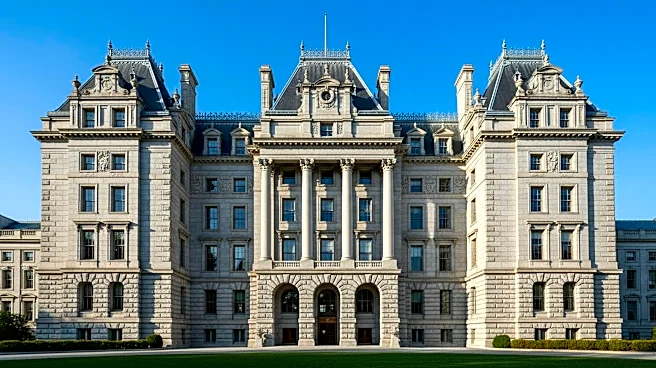
A federal district judge has ruled that paint tests can proceed on the Eisenhower Executive Office Building, located next to the White House. This decision advances President Trump’s plans to apply a new coat of white paint to the 19th-century historic
landmark. The proposal to paint the granite building has drawn criticism from preservationists, architects, and historians, who argue that painting granite is inappropriate and could lead to moisture entrapment and stone degradation. U.S. District Judge Dabney L. Friedrich stated that the plaintiffs, including cultural preservationist groups, failed to demonstrate that the minimal tests would cause irreparable harm. The planned tests involve approximately 8 square feet of the building's exterior and several panels not visible to the public. The judge emphasized that while these limited tests can proceed, she would intervene if the administration moved beyond this scope. A status report is due next Tuesday, with regular reports to follow.
Why It's Important?
This ruling is significant as it allows a preliminary step in President Trump's broader initiative to 'remake and beautify' the nation's capital, specifically impacting a historic federal building. The controversy highlights a tension between presidential directives and the concerns of cultural preservationists regarding the integrity of historic landmarks. The potential cost of the paint job, estimated at $7.5 million, also raises questions about the allocation of public funds for such projects. The legal challenge centers on whether the General Services Administration (GSA) can delegate its authority for such a project to the Executive Office, a point that remains a larger question before the court. The outcome of this case could set a precedent for how future renovations and aesthetic changes are handled for other historic properties across the country, potentially affecting the balance of power between executive authority and preservation regulations.
What's Next?
While the paint tests are permitted to move forward, the larger legal battle regarding the painting of the Eisenhower Executive Office Building is ongoing. U.S. District Judge Dabney L. Friedrich has requested a status report by next Tuesday and will require regular reports thereafter, indicating continued judicial oversight. The plaintiffs, cultural preservationist groups, remain committed to their case, arguing that the core issues regarding the delegation of authority from the GSA to the Executive Office are still unresolved. If the administration attempts to move beyond the limited testing, the judge has indicated she would not hesitate to intervene. The ultimate decision on whether the entire building can be painted will depend on the court's resolution of the broader legal questions, which could have long-term implications for the preservation of federal historic sites and the scope of presidential power in such matters.
Beyond the Headlines
The debate over painting the Eisenhower Executive Office Building extends beyond a simple aesthetic choice; it touches upon fundamental principles of historic preservation, executive authority, and the interpretation of federal regulations. The building, a prominent example of 19th-century architecture, holds significant historical and cultural value. Preservationists' concerns about painting granite reflect a broader understanding of architectural integrity and the long-term impact of such alterations on historic materials. The legal challenge also delves into the separation of powers, questioning whether the Executive Office can bypass established procedures and authorities, such as the GSA, for major renovation projects. This case could influence how future administrations approach the stewardship of national landmarks, potentially leading to more stringent guidelines or increased scrutiny for projects that could alter the historical character of federal properties. It underscores the ongoing tension between modernization efforts and the imperative to protect national heritage.