





What's Happening?
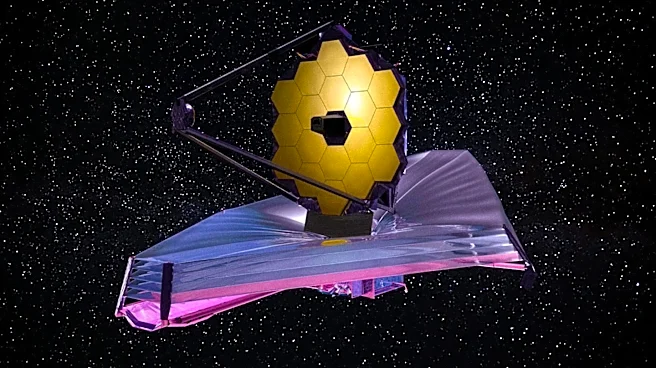
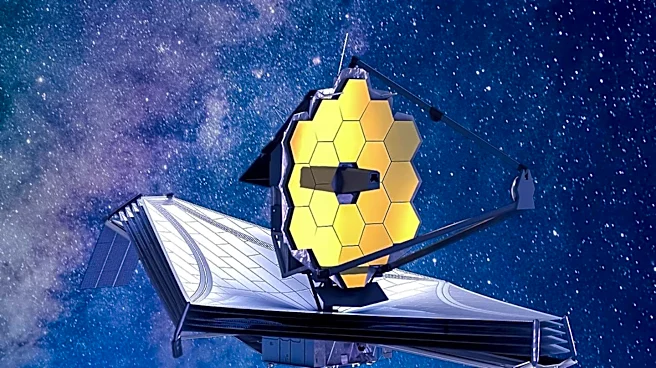
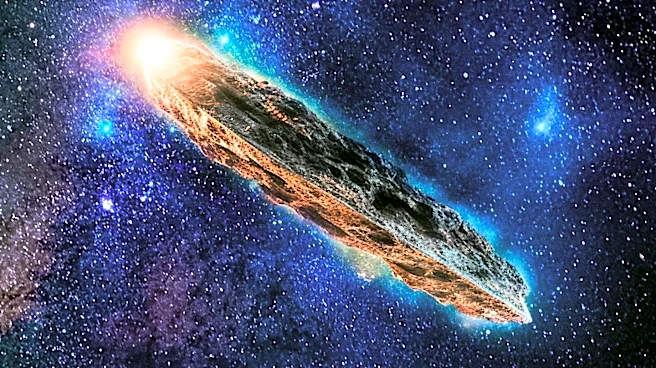
Recent studies of the interstellar comet 3I/ATLAS have provided new insights into its origins and composition. Data from the James Webb Space Telescope (JWST) and the European Southern Observatory's Very Large Telescope suggest that 3I/ATLAS is between
10 and 12 billion years old, making it more than twice the age of our solar system. The comet's isotopic composition, including high ratios of carbon-12 to carbon-13 and nitrogen-14 to nitrogen-15, indicates it formed in a distant, ancient planetary system. These findings suggest that 3I/ATLAS originated on the outskirts of its parent star's protoplanetary disk, far from the influence of giant planets.
Why It's Important?
The study of 3I/ATLAS provides a unique opportunity to understand the conditions and processes of planetary formation in other parts of the galaxy. The comet's ancient age and unique isotopic composition offer clues about the chemical environment of its origin, which differs significantly from that of our solar system. This research enhances the understanding of the diversity of planetary systems and the potential for life in the universe. The findings also underscore the importance of studying interstellar objects as they pass through our solar system, offering a glimpse into the history and evolution of distant planetary systems.
What's Next?
As more interstellar objects are discovered, scientists will continue to study their compositions to gain further insights into the conditions of their formation. Future missions and telescopes may focus on capturing detailed data from these objects, enhancing the understanding of planetary formation across the galaxy. The study of 3I/ATLAS and similar objects will likely inform models of planetary system evolution and the search for habitable worlds beyond our solar system.