



What's Happening?
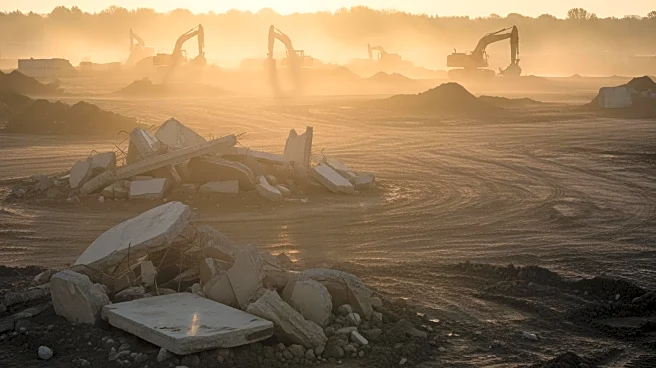
The United States is urging Israel to take responsibility for clearing the extensive debris in the Gaza Strip, a result of two years of conflict. This initiative is part of a broader plan to begin reconstruction efforts under the second phase of a ceasefire
agreement. The estimated 68 million tons of rubble, equivalent to the weight of 186 Empire State Buildings, poses a significant challenge. Israel has agreed in principle to this request, which is expected to cost hundreds of millions of shekels. The U.S. aims to start rebuilding in the Rafah area, showcasing President Trump's vision for Gaza's recovery. This effort is intended to attract displaced residents back to the south before expanding to other areas. Meanwhile, the U.S. is also planning to deploy an international stabilization force in Gaza by early 2026, with potential troop contributions from Indonesia and Azerbaijan.
Why It's Important?
This development is significant as it highlights the U.S.'s strategic involvement in Middle Eastern geopolitics, particularly in the Israeli-Palestinian conflict. The reconstruction of Gaza is crucial for regional stability and could influence the return of displaced populations. The U.S.'s demand for Israel to bear the financial and physical burden of debris removal underscores the complexities of international aid and responsibility. Additionally, the deployment of an international stabilization force could alter the security dynamics in the region, potentially affecting the power balance with groups like Hamas. The focus on reconstruction over demilitarization has raised concerns in Israel, indicating potential friction in U.S.-Israel relations.
What's Next?
The next steps involve Israel hiring specialized companies to clear the debris, a process that will likely take considerable time and resources. The U.S. is expected to continue pressuring Israel to advance to the next phase of the ceasefire, contingent on the return of hostage Ran Gvili's body. The international stabilization force's deployment will require coordination among contributing nations, and its effectiveness in dismantling Hamas's military capabilities remains uncertain. President Trump plans to announce the Board of Peace's composition, which will oversee Gaza's governance and reconstruction, at the start of 2026. This board's influence and the involvement of international leaders could shape the future governance of Gaza.