



What's Happening?
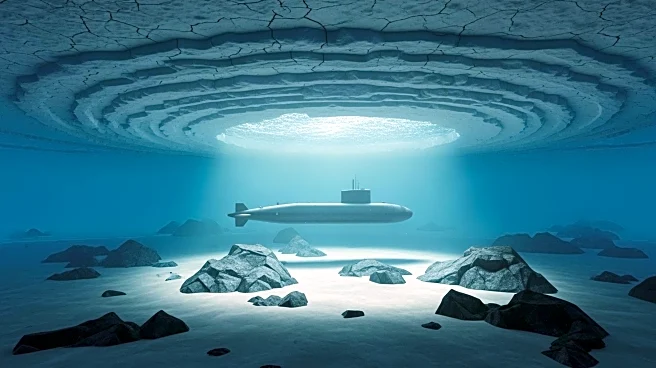
An unmanned submarine named Ran, operated by researchers from the University of Gothenburg, has discovered unusual under-ice structures beneath West Antarctica's Dotson Ice Shelf. The mission, led by Professor Anna Wåhlin, aimed to understand how ocean
currents affect ice shelf stability and contribute to sea level changes. Ran mapped 54 square miles of the ice shelf's underside, revealing features such as flat plateaus, terraced steps, and teardrop-shaped pits, which are formed by basal melt. These structures were previously hidden from satellite imagery. The findings highlight the impact of Circumpolar Deep Water, a warm salty current, which erodes the ice shelf from below, particularly affecting the western side of Dotson. The mission faced challenges, including the loss of contact with Ran during its final mission, leaving the cause of its disappearance unknown.
Why It's Important?
The discovery of these under-ice structures is significant for understanding the dynamics of ice shelf melting and its implications for global sea level rise. The detailed mapping of the Dotson Ice Shelf provides insights into how warm ocean currents can accelerate ice loss, potentially destabilizing glaciers and increasing sea levels. This research is crucial for refining models that predict future ice loss in Antarctica, which has already contributed significantly to sea level rise since 1979. The findings underscore the importance of monitoring and understanding the interactions between ice shelves and ocean currents, as these processes play a critical role in shaping the Earth's climate and coastal environments.
What's Next?
The loss of the Ran submarine presents challenges for future missions, but the data collected prior to its disappearance will continue to inform research on ice shelf dynamics. Scientists will likely focus on incorporating the newly discovered structures into predictive models to better estimate the rate of ice loss in West Antarctica. Further exploration and mapping of other ice shelves may be pursued to gain a comprehensive understanding of Antarctic ice melt processes. Additionally, efforts to recover or replace the lost submarine could be considered to continue the exploration of under-ice environments.
Beyond the Headlines
The findings from the Ran mission highlight the complexity of ice shelf melting processes, which are not fully captured by current models. The presence of terraces, channels, and fractures suggests that melting is influenced by localized ocean currents and turbulence, which can concentrate damage in specific areas. This research may prompt a reevaluation of how ice shelf stability is assessed, potentially leading to more accurate predictions of sea level rise. The study also emphasizes the need for advanced technologies and methodologies to explore remote and challenging environments like Antarctica.