
What's Happening?
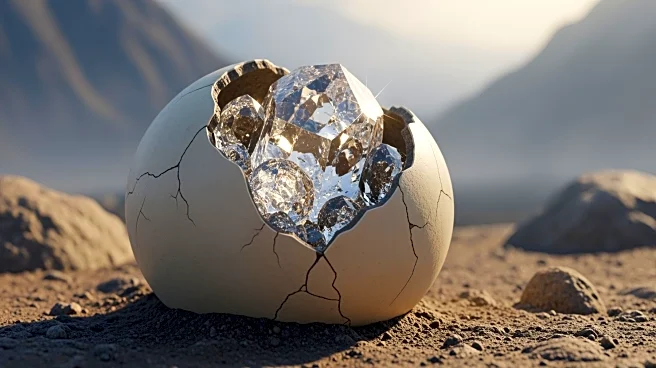
In eastern China, paleontologists have uncovered two dinosaur eggs, each approximately five inches in diameter, filled with large mineral crystals instead of embryonic remains. Led by Qing He from Anhui
University and the Nanjing Institute of Geology and Palaeontology, the research team identified these eggs as a new oospecies, Shixingoolithus qianshanensis, based on their shell characteristics. The eggs belong to the Stalicoolithidae oofamily, known for thick-shelled, spherical eggs. The discovery was made in the Qianshan Basin, where groundwater rich in minerals seeped into the eggs over millions of years, leading to the crystallization inside. Although the parent species could not be identified, the eggs are believed to be from plant-eating ornithopods, which were prevalent from the Late Jurassic to the Late Cretaceous periods.
Why It's Important?
This discovery adds significant data to the understanding of dinosaur reproduction, particularly in southern China. The presence of such well-preserved eggs provides insights into the nesting behaviors and embryonic development of ornithopods, a group of dinosaurs that thrived millions of years ago. The findings also contribute to the broader paleontological knowledge of how these creatures adapted to their environments and how their reproductive strategies evolved over time. Such discoveries are crucial for reconstructing ancient ecosystems and understanding the impact of long-term climate changes on prehistoric life.
What's Next?
Future research may focus on further excavations in the Qianshan Basin and similar regions to uncover more fossilized eggs and potentially identify the parent species. Continued study of these eggs could provide more detailed information on the environmental conditions of the time and how they influenced dinosaur reproduction. Additionally, comparisons with other fossil sites may help paleontologists develop a more comprehensive picture of dinosaur life and extinction events.
Beyond the Headlines
The discovery of crystal-filled dinosaur eggs highlights the unique geological processes that can preserve fossils in extraordinary detail. The conditions in eastern China, with its volcanic and sedimentary environments, have allowed for the preservation of not only bones but also entire nests and embryonic remains. This enhances the ability of scientists to study the early life stages of dinosaurs and their ecological interactions. Such findings also underscore the importance of interdisciplinary research, combining geology and paleontology to unlock the secrets of Earth's distant past.