
What's Happening?
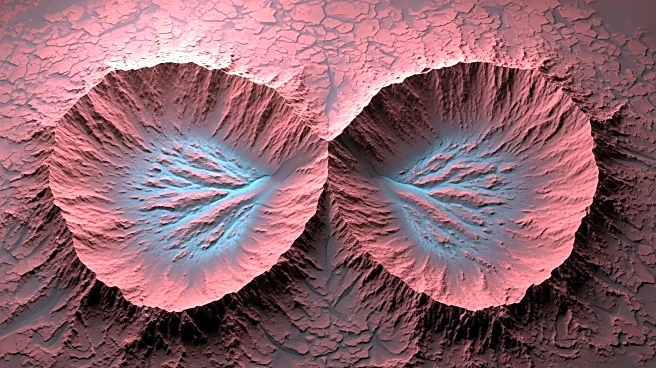
The European Space Agency (ESA) has released new images of a 'cosmic butterfly' crater on Mars, captured by the Mars Express orbiter. This city-sized crater, located in the Idaeus Fossae region, was formed
by an asteroid impact at a low angle, creating a unique butterfly shape with smooth rocky wings. The images suggest that the crater's material has been fluidized, indicating the presence of water during the impact. This discovery adds to the understanding of Mars' geological history and the role of water in shaping its surface.
Why It's Important?
The identification of water traces in the 'cosmic butterfly' crater provides valuable insights into Mars' past climate and the potential for ancient life. Understanding the distribution and history of water on Mars is crucial for future exploration missions, as it informs the search for life and the selection of landing sites. The crater's unique formation also offers a rare opportunity to study the effects of low-angle impacts, contributing to broader planetary science knowledge.
Beyond the Headlines
The discovery of the 'cosmic butterfly' crater highlights the importance of international collaboration in space exploration. ESA's Mars Express mission, in operation since 2003, continues to provide critical data that complements NASA's efforts. The study of such craters can reveal hidden layers of Mars' surface, offering clues about the planet's geological processes and the conditions that existed during its formation. This ongoing research underscores the dynamic nature of Mars and the potential for future discoveries.