
What's Happening?
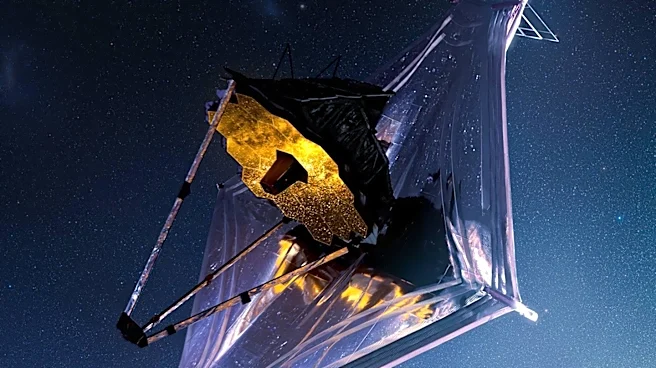
Astronomers using the James Webb Space Telescope (JWST) have detected water molecules and silicate dust around IRS 3, a giant star located only 0.55 light-years from Sagittarius A*, the Milky Way’s central black hole. This discovery, detailed in a study
by Florian Peißker and colleagues in Astronomy & Astrophysics, demonstrates that dust production and molecular material can persist in the intense radiation environment surrounding a supermassive black hole. The region around Sagittarius A* is characterized by extreme radiation, powerful winds, and gravitational stress, making the survival of fragile molecules like water a significant puzzle. IRS 3, a 72-million-year-old star with about six times the Sun's mass, is nearing the end of its life and shedding layers of gas and dust. The JWST's Mid-Infrared Instrument (MIRI) provided the most complete infrared spectrum for IRS 3 to date, confirming its oxygen-rich, silicate-based composition and, notably, the presence of water molecules. The research team suggests that the star's dusty envelope is thick enough to shield these fragile molecules from the harsh ultraviolet and X-ray radiation.
Why It's Important?
The detection of water molecules and silicate dust so close to the Milky Way's central black hole is highly significant for astrophysics. It challenges the previous assumption that the extreme conditions in galactic centers would destroy such fragile molecular material. This finding indicates that stars in these hostile environments can continue to enrich their surroundings with dust and molecules, which are fundamental building blocks for planets and potentially life. Understanding how these materials survive and are distributed in galactic centers provides crucial insights into the chemical evolution of galaxies and the potential for star and planet formation in regions previously thought to be inhospitable. It also helps to address fundamental questions about how stars behave in some of the universe's most extreme environments, offering a more nuanced view of cosmic chemistry and the resilience of molecular structures under intense radiation.
What's Next?
Future research will likely focus on further characterizing the shielding mechanisms that allow water and other molecules to survive near supermassive black holes. Scientists will aim to understand the precise composition and density of the dusty envelopes around stars like IRS 3. This will involve more detailed spectroscopic observations and advanced modeling to simulate the complex interactions between radiation, dust, and molecules. The findings will also encourage searches for similar molecular detections around other stars in galactic centers, both within the Milky Way and in other galaxies, to determine if this phenomenon is widespread. This ongoing work will contribute to a more comprehensive understanding of the chemical processes occurring in extreme cosmic environments and their implications for the broader cycle of matter in the universe.
Beyond the Headlines
This discovery has broader implications for the search for extraterrestrial life and the conditions necessary for its emergence. While the immediate vicinity of a supermassive black hole is not considered habitable, the presence of water molecules in such extreme conditions suggests that the fundamental ingredients for life might be more widely distributed and resilient than previously thought. It challenges the notion that only quiescent regions of galaxies are conducive to complex chemistry. This finding could inspire new theories about how water and organic molecules are transported and preserved across vast cosmic distances, potentially seeding new star systems and planets. It underscores the universe's remarkable capacity for chemical complexity even in the most unlikely places, pushing the boundaries of our understanding of astrobiology and cosmic habitability.