
What's Happening?
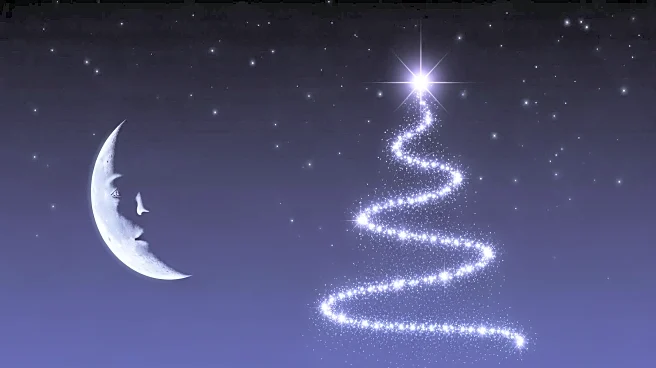
Recent social media posts have falsely claimed that a celestial 'smiley face' will appear in the sky on Christmas, featuring an alignment of Venus, Saturn, and a crescent Moon. This phenomenon, known as a triple
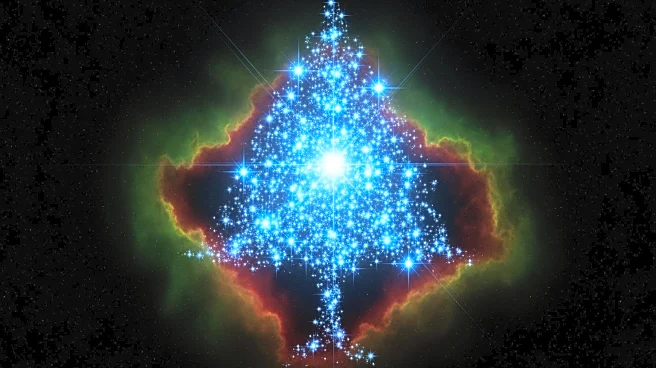
conjunction, is not scheduled to occur on Christmas, as confirmed by astronomy calendars and NASA guides. The 'smiley face' illusion is an optical effect that requires specific alignments of celestial bodies, which will not be present this holiday season. Instead, skywatchers are encouraged to observe the Christmas Tree Cluster, a star grouping located in the constellation Monoceros, visible with binoculars or a small telescope. This cluster, shaped like a pine tree, offers a festive sight in the night sky.
Why It's Important?
The spread of misinformation about astronomical events highlights the need for accurate scientific communication. While the idea of a 'smiley face' moon is appealing, it underscores how easily false information can circulate, especially on social media. Encouraging the public to engage with real astronomical phenomena, like the Christmas Tree Cluster, can foster interest in science and provide educational opportunities. This event also serves as a reminder of the importance of consulting reliable sources for information about celestial events, which can enhance public understanding and appreciation of astronomy.
What's Next?
As the Christmas Tree Cluster becomes a focal point for skywatchers, astronomy enthusiasts and educators may use this opportunity to promote awareness of other celestial events. Observatories and science centers might organize viewing events or educational sessions to engage the public. Additionally, this situation could lead to discussions about improving scientific literacy and critical thinking skills, particularly in evaluating information shared on social media. Future astronomical events will likely continue to capture public interest, providing ongoing opportunities for education and engagement.
Beyond the Headlines
The fascination with celestial events like the 'smiley face' moon reflects a broader cultural interest in the night sky and its mysteries. This interest can be leveraged to promote STEM education and inspire future generations of scientists and astronomers. Moreover, the Christmas Tree Cluster's visibility during the holiday season offers a unique cultural connection, blending scientific observation with festive traditions. This intersection of science and culture can enrich public engagement with astronomy and highlight the beauty and wonder of the universe.