





What's Happening?
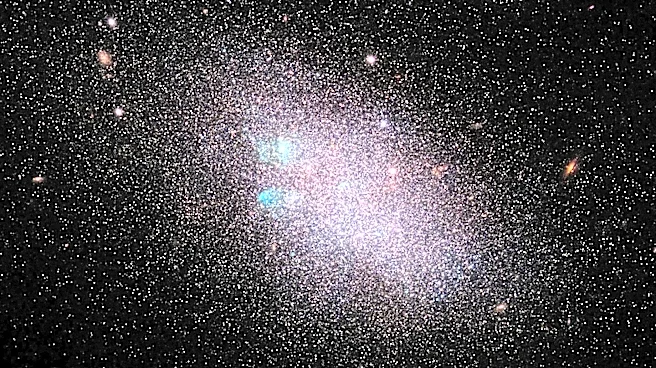
Julian Shapiro, a high school student at the time of his discovery, identified three unusual dwarf galaxies near the large spiral galaxy M101, now officially named Shapiro I, Shapiro II, and Shapiro III. These galaxies defy conventional astronomical expectations
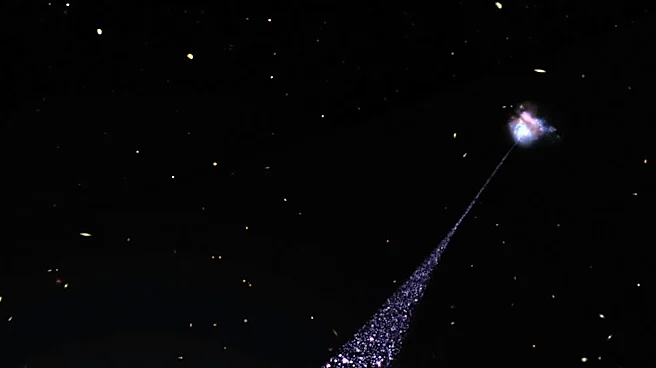
because, despite being isolated from giant neighbors and thus expected to actively form new stars, they have almost entirely ceased star formation—a phenomenon known as 'quenching.' Shapiro conducted computer simulations to investigate this mystery, which suggested that these systems must have been influenced by a powerful external source. The most probable explanation is that these are 'backsplash galaxies,' which previously passed too close to the gravitational center of the enormous Messier 101 (Pinwheel Galaxy). During this close encounter, immense ram pressure and gravitational forces stripped the dwarf systems of their gas reservoirs, essential for star formation, before ejecting them back into intergalactic space.
Why It's Important?
This discovery is significant because it challenges existing assumptions about star formation in isolated dwarf galaxies and provides empirical evidence for the 'backsplash galaxy' phenomenon. Dwarf galaxies are fundamental building blocks of the universe, and understanding their evolution is crucial for a complete picture of cosmic development. Shapiro's findings, published in The Astrophysical Journal, demonstrate how access to open astronomical data can empower young, talented individuals to make genuine scientific breakthroughs. The existence of such 'quenched' orphan galaxies, predicted by the standard cosmological model with cold dark matter, has been difficult to confirm in our cosmic neighborhood. Shapiro's careful distance calculations offer a new methodology for identifying similar galactic outcasts, which could lead to a more comprehensive understanding of galaxy interactions and the distribution of dark matter.
What's Next?
Julian Shapiro, now studying astrophysics at the University of California, Berkeley, is preparing for further observations using high-resolution space telescopes. These observations aim to precisely measure the orbital parameters of the discovered systems. The insights gained from this research are expected to contribute to the development of new algorithms for finding similar galactic objects in the future. Upcoming observatories, such as the Vera C. Rubin Observatory, are anticipated to help identify hundreds of these 'backsplash galaxies,' which would definitively confirm the theory formulated by Shapiro. This ongoing research will continue to refine our understanding of galaxy evolution and the complex interplay of gravitational forces in the universe.
Beyond the Headlines
Shapiro's achievement underscores the democratizing potential of open scientific data and the impact that young researchers can have on established fields. His work not only contributes to astrophysics but also serves as an inspiring example of how curiosity and rigorous analysis can lead to significant discoveries, regardless of age or traditional academic standing. The concept of 'quenching' in dwarf galaxies, where star formation ceases, highlights the dynamic and often violent processes that shape galactic environments. This phenomenon, driven by powerful gravitational and ram pressure forces, illustrates the intricate balance of conditions required for star birth and the profound influence of larger galactic structures on their smaller counterparts. The ongoing study of these 'dead' orphan galaxies will continue to shed light on the less obvious mechanisms of cosmic evolution.