






What's Happening?
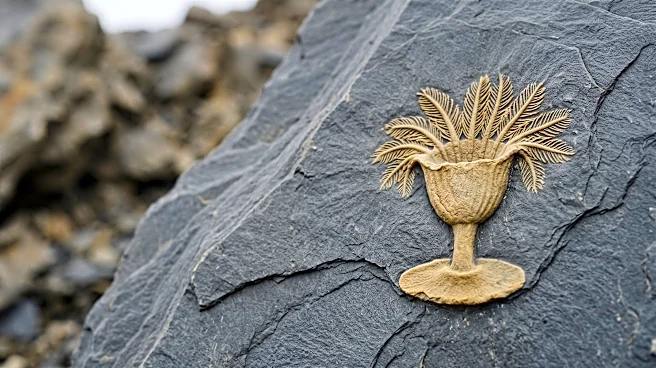
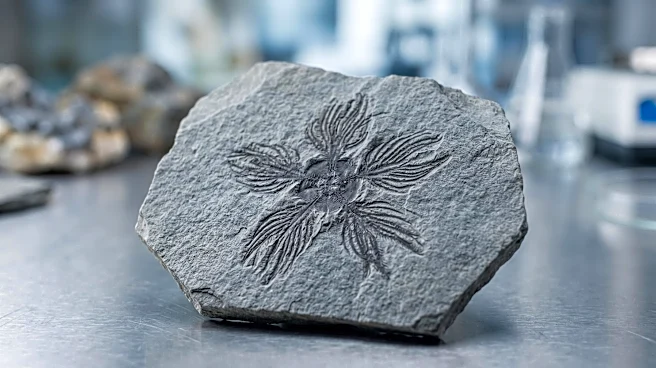
Researchers have discovered exceptionally preserved fossils of a previously unknown ancient sea creature, Yujingia glutenotunica, in southwestern China. These fossils, dating back 518 million years to the Cambrian Period, are providing new insights into
the evolution of starfish and their relatives. The creature, measuring between 8 and 22 millimeters long, offers remarkable details of its soft-bodied structure, including its body, gut, and appendages. Unlike many Cambrian fossils that only preserve hard parts, Yujingia glutenotunica was preserved without a mineralized skeleton, allowing scientists to examine its feeding organs. The discovery suggests that sophisticated tentacle-based feeding evolved much earlier than previously thought, before echinoderms developed their characteristic mineralized skeletons. This finding challenges the earlier hypothesis that the common ancestor of modern ambulacrarians was a worm-like creature that primarily filtered food through its pharynx. Instead, Yujingia glutenotunica indicates that this ancestor might have been a tentacle-feeding animal, bridging a crucial gap between early Cambrian tentacle-bearing animals and modern echinoderms and hemichordates.
Why It's Important?
This discovery is important because it significantly alters the scientific understanding of the evolutionary origins of a major group of marine animals, the ambulacrarians, which include starfish, sea urchins, and acorn worms. By placing Yujingia glutenotunica close to the last common ancestor of living ambulacrarians, researchers are gaining a clearer picture of how the diverse body plans of these creatures emerged. The finding that sophisticated tentacle-based feeding evolved early in the Cambrian Period before the development of mineralized skeletons provides a new framework for understanding the ecological and evolutionary pressures that shaped early animal life. This shift in understanding can influence future research into paleontology, evolutionary biology, and marine ecosystems, potentially leading to a re-evaluation of other Cambrian fossil records. The exceptional preservation of Yujingia glutenotunica also highlights the importance of specific fossil sites, like those in southwestern China, for providing detailed insights into ancient life forms that lacked hard parts, which are typically less likely to be preserved.
What's Next?
The research team will likely continue to analyze the anatomical characteristics of Yujingia glutenotunica and compare them with other known Cambrian fossils and modern species to further refine the evolutionary tree of ambulacrarians. This discovery may prompt paleontologists to re-examine existing fossil collections for similar soft-bodied organisms or re-interpret previously ambiguous fossil evidence. Future studies could focus on identifying other early tentacle-feeding organisms to corroborate the hypothesis that this feeding mechanism was an early evolutionary development. The insights gained from Yujingia glutenotunica could also inform studies on the genetic and developmental pathways that led to the diverse forms seen in modern echinoderms and hemichordates. Additionally, the findings may encourage further exploration and excavation in Cambrian fossil sites in China and other regions known for exceptional preservation, potentially leading to more discoveries that shed light on the 'Cambrian explosion' and the rapid diversification of animal life.
Beyond the Headlines
The discovery of Yujingia glutenotunica underscores the dynamic nature of scientific understanding, particularly in fields like paleontology where new evidence can fundamentally shift long-held theories. It highlights the continuous process of scientific inquiry, where each new fossil find can challenge and refine our knowledge of Earth's ancient past. The exceptional preservation of this soft-bodied creature also emphasizes the rare and invaluable conditions required for such fossils to form, making sites like the one in southwestern China critical for understanding the full scope of ancient biodiversity. This research contributes to a broader understanding of the origins of complex life and the mechanisms of evolution, reminding us that the history of life on Earth is far more intricate and surprising than we often imagine. It also serves as a testament to the meticulous work of paleontologists who piece together the puzzle of life's history from fragments of the distant past.