


What's Happening?
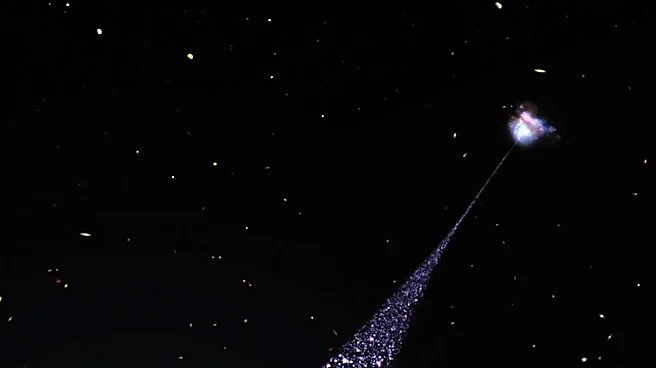
A new theory suggests that 'dark stars,' hypothetical primordial stars powered by self-annihilating dark matter, could have been the initial seeds for supermassive black holes. These dark stars, unlike conventional stars, would remain cool while accreting
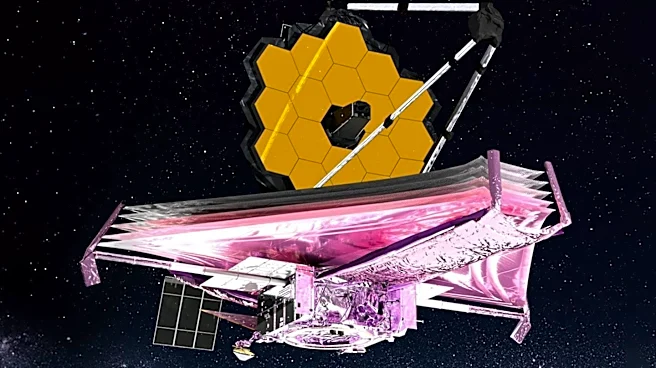
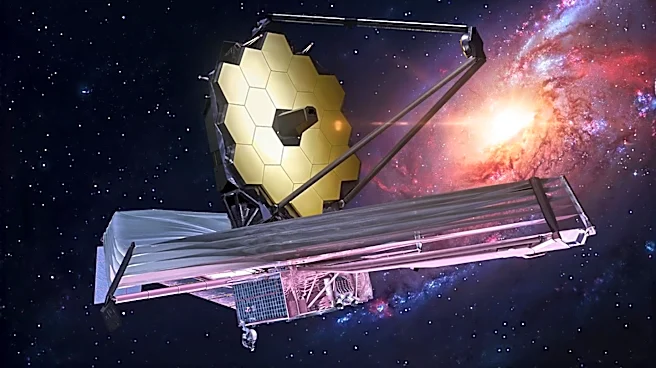
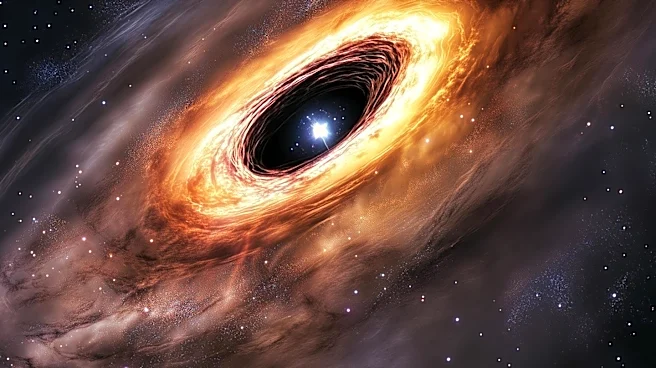
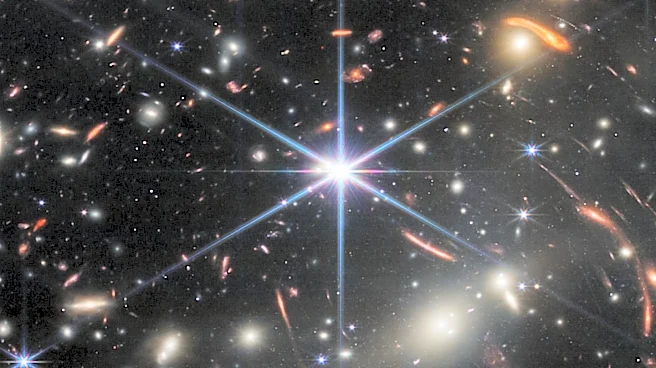
matter, growing to millions of times the sun's mass before collapsing into massive black holes. These massive black hole seeds could then collide and merge to form the supermassive black holes observed today. This theory aims to explain the rapid growth of supermassive black holes in the early universe, which the James Webb Space Telescope (JWST) has detected before the universe was even a billion years old. The researchers, Cosmin Ilie and Sohan Ghodla of Colgate University, propose that the mysterious hum of gravitational waves detected in 2023 by pulsar timing arrays could be an echo of these dark stars.
Why It's Important?
This theory is significant because it offers a potential solution to a major puzzle in astrophysics: how supermassive black holes grew so rapidly in the early universe. Current models struggle to explain their existence at such early cosmic times, as the proposed feeding and merger chains for black hole formation typically require over a billion years. If dark stars indeed served as heavy seeds, it would provide a head start for supermassive black hole growth, aligning with JWST observations. Furthermore, the theory connects the existence of dark stars to the gravitational wave background detected by pulsar timing arrays. This connection provides a testable hypothesis, as the characteristics of this background could reveal information about the abundance of heavy black hole seeds in the early universe. This could lead to a more complete understanding of cosmic evolution and the role of dark matter in shaping the universe.
What's Next?
Determining the correctness of this theory will require improvements in pulsar timing array measurements of the gravitational wave background. Scientists will need to enhance their understanding of black hole populations and their characteristics in the early universe. The research team modeled the environment of these black hole seeds and their merger rates, calculating their influence on the gravitational wave background. They found that supermassive dark star remnants could significantly contribute to the detected gravitational wave background. Future research will focus on refining these models and comparing them with more precise observational data. The key determining factor will be the masses of the dark matter haloes where these dark stars and heavy black hole seeds form. This ongoing research could provide a new window into the birth of the first supermassive black holes.
Beyond the Headlines
The concept of dark stars and their role in seeding supermassive black holes delves into the fundamental nature of dark matter and its profound influence on cosmic structures. This theory highlights the interconnectedness of seemingly disparate phenomena, from the elusive dark matter to the colossal black holes that anchor galaxies. It challenges the conventional understanding of stellar evolution and black hole formation, suggesting a more complex and dynamic early universe. The ethical implications revolve around the pursuit of knowledge and the scientific method's ability to refine our understanding of reality. Culturally, such theories inspire awe and curiosity about the cosmos, pushing the boundaries of human imagination. The long-term shift could be towards a more integrated cosmological model that fully incorporates dark matter's active role in the universe's development, potentially leading to new insights into the origins of galaxies and the large-scale structure of the cosmos.