

What's Happening?
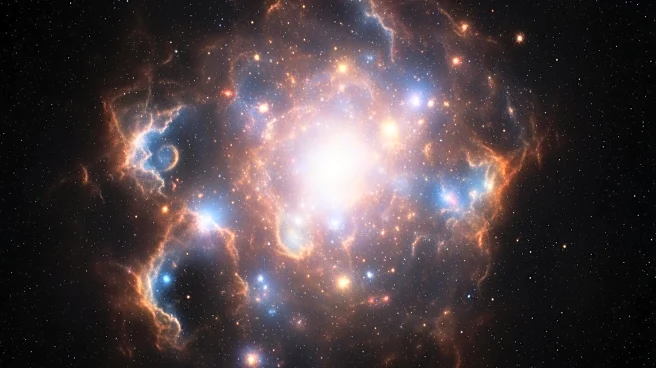
A team of 48 astronomers, led by the University of Massachusetts Amherst, has discovered a population of dusty, star-forming galaxies that formed nearly 13 billion years ago. These galaxies, identified using the Atacama Large Millimeter/submillimeter
Array (ALMA) and the James Webb Space Telescope, challenge existing models of the universe by suggesting that star formation occurred earlier than previously thought. The findings, published in The Astrophysical Journal Letters, provide a potential link between ultradistant bright galaxies and early 'quiescent' galaxies that ceased star formation about two billion years after the Big Bang.
Why It's Important?
This discovery is pivotal for the field of astronomy as it suggests that current models of the universe's formation may be incomplete. By identifying these ancient galaxies, scientists can gain insights into the early universe's conditions and the timeline of star formation. This could lead to a revision of cosmic history and enhance our understanding of galaxy evolution, impacting future astronomical research and theories.
What's Next?
Further research is needed to confirm the implications of this discovery. Astronomers will likely conduct additional observations and analyses to refine their understanding of these galaxies and their role in the universe's evolution. This could involve using advanced telescopes and technologies to explore other regions of the universe and identify similar galactic populations.