
What's Happening?
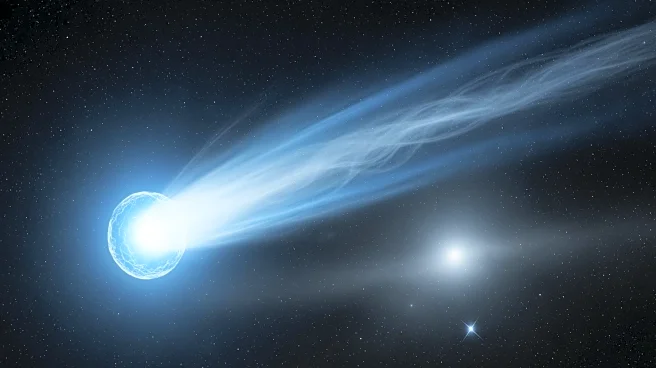
NASA's Hubble Space Telescope has captured new images of the interstellar comet 3I/ATLAS as it travels through the solar system. The images were taken using the Wide Field Camera 3 instrument, which allows
for a detailed panchromatic view of celestial objects. The comet, first spotted in the summer of 2025 by the ATLAS survey telescope in Chile, is notable for its high velocity and hyperbolic trajectory, indicating it is not bound by the Sun's gravity. This makes 3I/ATLAS only the third known interstellar object to pass through our solar system. The comet will not come closer than 170 million miles to Earth, posing no threat. As it moves, the comet creates streaks of light against the background stars, a phenomenon captured in the Hubble images.
Why It's Important?
The observation of 3I/ATLAS provides a rare opportunity for scientists to study an interstellar object, offering insights into the composition and behavior of celestial bodies from outside our solar system. This event allows astronomers to gather data that could enhance understanding of the universe's formation and the processes governing interstellar travel. The comet's passage through the solar system is a significant event for the scientific community, as it could lead to discoveries about the materials and conditions present in other parts of the galaxy. The data collected may also contribute to the development of new theories about the origins of comets and their potential impact on planetary systems.
What's Next?
NASA plans to continue observing 3I/ATLAS for several more months, utilizing various space telescopes to track its journey and gather more information. These observations aim to maximize the scientific return before the comet exits the solar system. The ongoing study will involve collaboration among different NASA missions, focusing on understanding the comet's properties and trajectory. The findings from these observations could inform future research and exploration strategies, potentially influencing how scientists approach the study of other interstellar objects that may be discovered in the future.