
What's Happening?
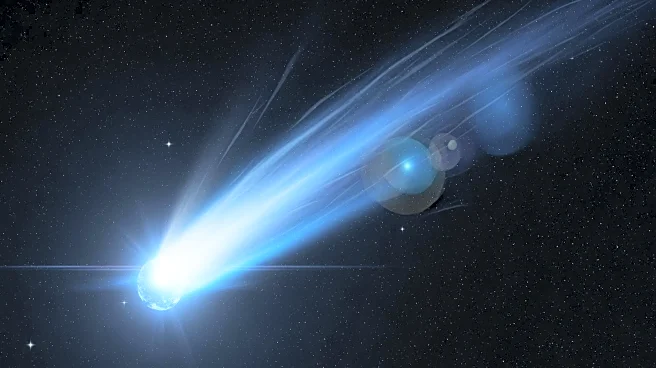
The interstellar comet 3I/ATLAS has recently made its closest approach to Earth, coming within approximately 168 million miles (270 million kilometers) of the planet. This event marks a significant moment
as 3I/ATLAS is only the third interstellar object confirmed to have entered our solar system. Despite its proximity, scientists have assured that there is no threat to Earth due to the vast distance maintained during its passage. The comet's origin from outside the solar system has intrigued astronomers and the public alike, leading to increased interest and speculation about its characteristics and trajectory.
Why It's Important?
The passage of 3I/ATLAS is significant for both scientific and public interest reasons. For scientists, the comet provides a rare opportunity to study an object from another star system, potentially offering insights into the composition and behavior of celestial bodies beyond our solar system. This could enhance understanding of the universe's formation and the processes that govern interstellar travel. For the public, the event has captured imagination and curiosity, highlighting the vastness and mystery of space. The comet's journey also underscores the importance of continued investment in space observation and research, which can lead to discoveries that expand human knowledge and inspire future generations.
What's Next?
Following the comet's closest approach, astronomers will likely continue to monitor 3I/ATLAS as it travels through the solar system. Observations and data collection will be crucial in analyzing its composition and trajectory, contributing to the broader understanding of interstellar objects. The scientific community may also engage in discussions and collaborations to share findings and develop new hypotheses about the nature of such objects. Public interest may lead to increased support for space exploration initiatives, potentially influencing policy and funding decisions related to space research.
Beyond the Headlines
The appearance of 3I/ATLAS raises questions about the frequency and nature of interstellar visitors to our solar system. It prompts considerations of the potential for future encounters with similar objects and the implications for planetary defense strategies. Additionally, the event highlights the interconnectedness of celestial phenomena and the need for international cooperation in space exploration. As technology advances, the ability to detect and study such objects will improve, potentially leading to groundbreaking discoveries about the universe and our place within it.