



What's Happening?
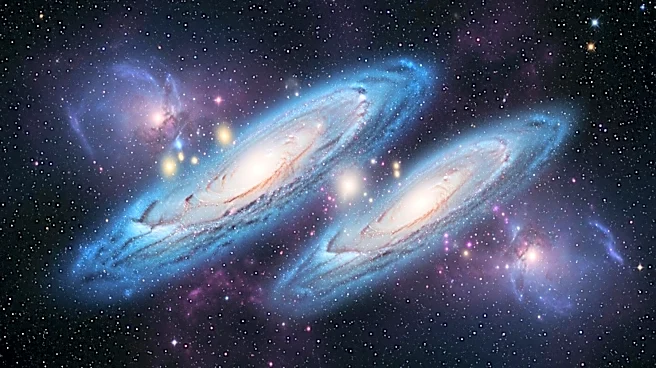
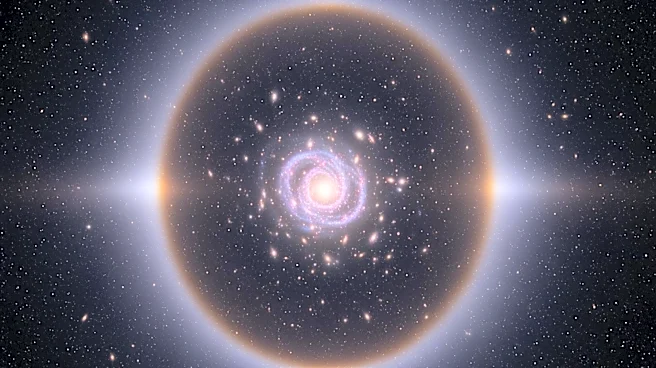
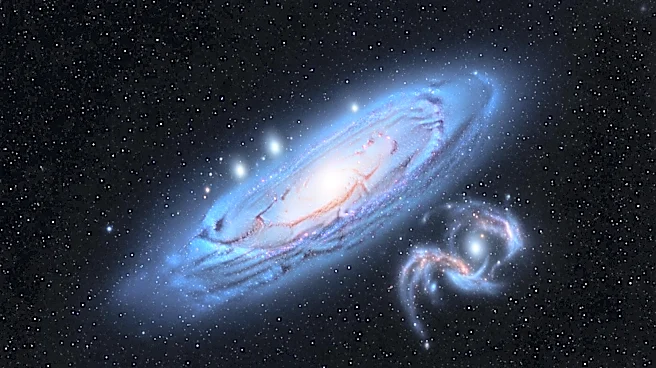
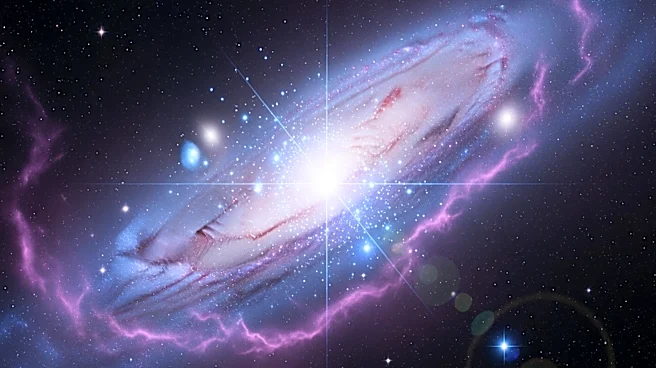
Astrophysicists have successfully reconstructed the history of the spiral galaxy NGC 1365, located outside the Milky Way, using space archaeology techniques. By analyzing the chemical signatures of the galaxy's gas clouds and comparing them with computer
models, researchers traced the galaxy's formation and evolution over 12 billion years. The study revealed that the central region of NGC 1365 formed early and became rich in heavy elements, while the outer disk developed more slowly. The galaxy has absorbed smaller dwarf galaxies over time, contributing fresh gas and new stars. This research marks a significant application of chemical archaeology beyond the Milky Way, providing insights into the galaxy's growth and development.
Why It's Important?
This study is pivotal in understanding the formation and evolution of spiral galaxies, offering a detailed view of NGC 1365's history. By mapping the chemical composition of the galaxy, scientists can infer the processes that shaped its structure and growth. This research could inform broader questions about the typical evolutionary paths of large spiral galaxies and their similarities to the Milky Way. Understanding these processes is crucial for developing comprehensive models of galaxy formation and evolution, which are fundamental to astrophysics. The findings may also influence future studies on galaxy interactions and the role of external gas accretion in galactic development.
Beyond the Headlines
The study raises questions about the uniqueness of NGC 1365's evolutionary path compared to other spiral galaxies. It remains unclear whether its growth is primarily driven by collisions with neighboring galaxies or by the accretion of external gas. Additionally, the research highlights the potential for chemical archaeology to uncover the histories of other galaxies, offering a new perspective on cosmic evolution. This approach could lead to a deeper understanding of the universe's history and the factors influencing galaxy formation, potentially reshaping current astrophysical theories.