




What's Happening?
An international team of scientists has developed a new method that significantly accelerates the discovery of pulsars using publicly available data from NASA's Fermi Gamma-ray Space Telescope. This innovative technique, detailed in a paper published
in Physical Review Letters, is approximately a million times faster than previous methods. By utilizing 15 years of Fermi data and a cryptography-inspired approach developed by Dotan Gazith and Barak Zackay from the Weizmann Institute of Science, the team successfully identified PSR J1622−7204, an isolated pulsar spinning 261 times per second, with only 10 hours of computing time on a standard processor. This discovery highlights the effectiveness of NASA's long-standing open science policy, which makes its scientific data freely accessible to the public. The Fermi mission, launched in 2008, surveys the entire sky every three hours, collecting high-energy gamma-ray data that becomes public after an initial calibration period.
Why It's Important?
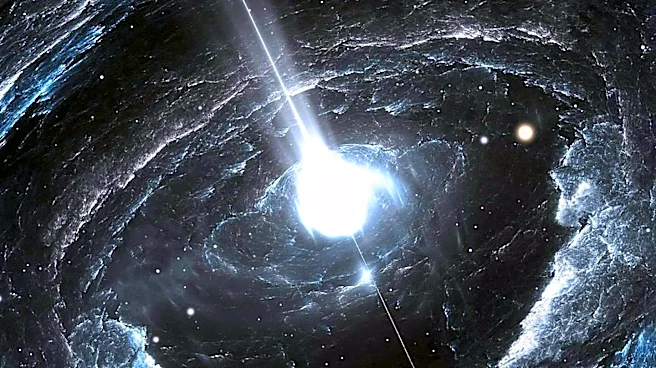
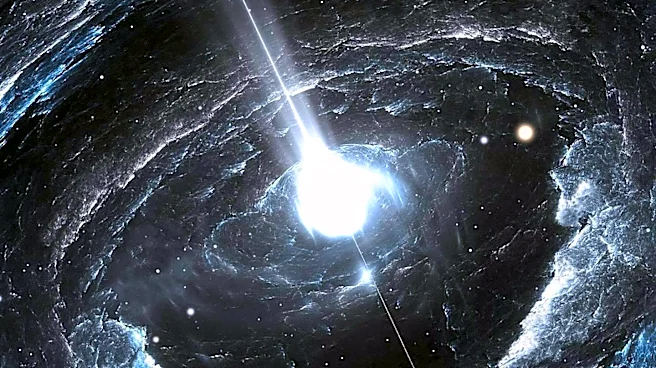
This breakthrough is crucial for astrophysics as it opens the door to discovering a significantly larger number of pulsars, which are rapidly spinning neutron stars. Pulsars are challenging to find due to the faintness of their signals amidst cosmic noise and the complex calculations required to pinpoint their characteristics. The new method, by transforming the search into a geometry problem and leveraging algorithms used in cryptography, drastically reduces the computational resources needed. This efficiency means that researchers can now explore vast datasets more thoroughly, potentially uncovering many pulsars that were previously undetectable. The increased discovery rate of pulsars will enhance understanding of extreme cosmic phenomena, neutron stars, and the fundamental physics of the universe. Furthermore, it validates the immense value of open science initiatives, demonstrating how public data access can foster innovation and accelerate scientific progress.
What's Next?
The team's immediate goal is to extend this new search method to find pulsars in binary systems, a task previously considered nearly impossible due to the gravitational distortions from companion stars. This next phase will likely combine the new algorithm with crowdsourced computing power from programs like Einstein@Home to maximize discovery potential. The continued availability of Fermi data, which grows with each passing year, will provide an ever-richer dataset for these advanced searches. The success of this method could also inspire its application to other complex data analysis challenges in astronomy and beyond. NASA's ongoing commitment to open data and tools like Fermitools will continue to empower researchers worldwide to apply novel approaches to existing datasets, leading to further unexpected discoveries and advancements in scientific understanding.
Beyond the Headlines
The application of cryptography-inspired algorithms to astronomical data analysis represents a fascinating interdisciplinary convergence. This development underscores how techniques from seemingly unrelated fields can provide powerful solutions to long-standing scientific problems. It also highlights the evolving nature of scientific discovery, moving beyond traditional observational methods to sophisticated computational approaches. The success of this project reinforces the ethical and practical benefits of open science, demonstrating that sharing data broadly can lead to unforeseen innovations and a more inclusive scientific community. This approach could serve as a model for other scientific disciplines facing similar 'big data' challenges, promoting a culture of collaboration and shared resources for global scientific advancement.