








What's Happening?
New research suggests that dark matter, which is invisible because it does not interact with light, might be detectable through gravitational waves. These waves are ripples in spacetime that occur when two black holes collide. The study proposes that if
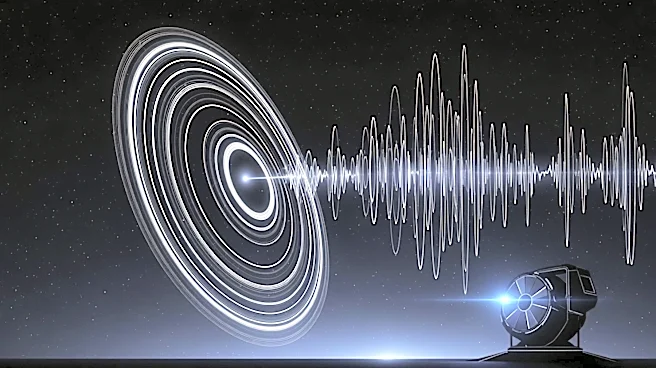
these black holes merge in areas dense with dark matter, the resulting gravitational waves could carry an imprint of the dark matter. This concept is likened to detecting a cough at a loud concert using sensitive instruments. The research team has developed a method to predict the shape of gravitational waves as they pass through dark matter. They analyzed data from LIGO and other detectors, identifying one signal that might indicate the presence of dark matter.
Why It's Important?
This research is significant as it offers a novel approach to studying dark matter, a substance that outweighs ordinary matter but remains largely mysterious. Detecting dark matter through gravitational waves could revolutionize our understanding of the universe's composition. It could also lead to advancements in physics by providing insights into particles outside the Standard Model. The ability to detect dark matter in this way could enhance the sensitivity of current and future gravitational wave detectors, potentially leading to groundbreaking discoveries in astrophysics.
What's Next?
The research team emphasizes that their findings are not a definitive detection of dark matter but a step towards understanding what to look for in future studies. As gravitational wave detectors become more sensitive, they may be able to confirm these findings. This could lead to more targeted investigations and potentially the development of new technologies to study dark matter. The scientific community will likely focus on refining detection methods and exploring the implications of these findings for our understanding of the universe.