
What's Happening?
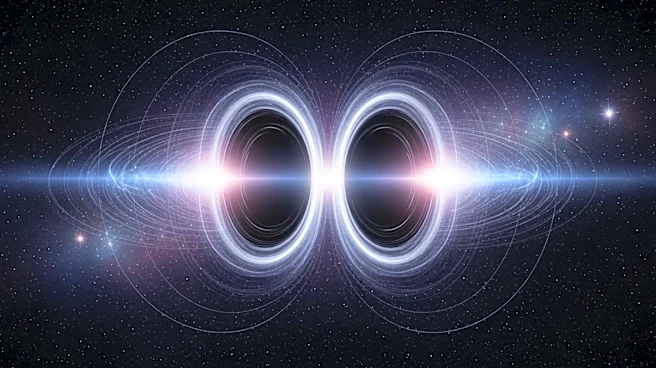
A new theoretical study proposes a solution to the black hole information paradox, a major unsolved problem in physics. The research, led by Richard Pinčák and his team, suggests that black holes may never
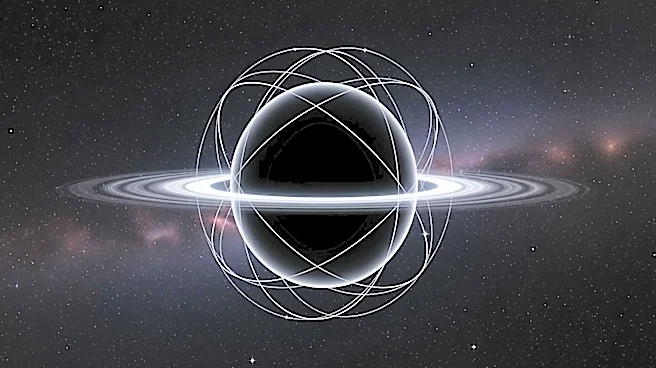
completely disappear, potentially preserving the information they contain. This theory is based on a seven-dimensional framework using a G2-manifold with torsion, which introduces a repulsive force at extreme densities, preventing complete gravitational collapse. The study posits that black holes leave behind stable remnants that act as memory archives, preserving information through quasi-normal modes.
Why It's Important?
This development could have significant implications for our understanding of quantum mechanics and the nature of reality. By potentially resolving the information paradox, the study bridges a gap between general relativity and quantum physics, two foundational yet often conflicting theories. The findings also suggest a geometric explanation for the mass hierarchy problem in particle physics, linking the structure of extra dimensions to the Higgs field. This could lead to new insights into the fundamental forces and particles that make up the universe, influencing future research in theoretical physics.
What's Next?
The theory presents testable predictions, such as the existence of stable black hole remnants that could contribute to dark matter. Detecting these remnants or their gravitational effects would provide strong support for the model. Additionally, traces of the seven-dimensional geometry might be observable in the cosmic microwave background or primordial gravitational waves. Future experiments and observations in these areas could validate the theory, potentially leading to a paradigm shift in our understanding of the universe.