
What's Happening?
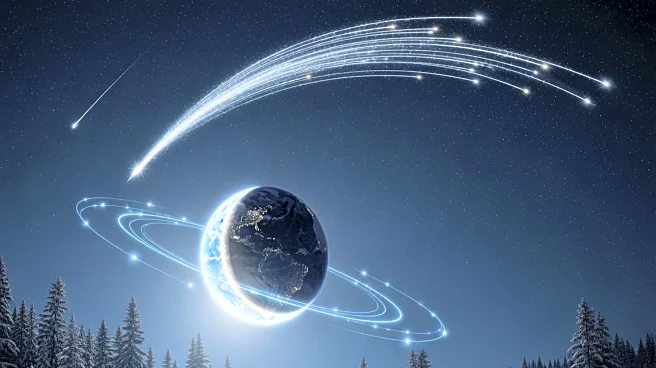
The Earth is currently at perihelion, the point in its orbit where it is closest to the Sun, approximately 1.5 million miles closer than its average distance of 93 million miles. Despite this proximity,
the Northern Hemisphere experiences winter due to the low angle of sunlight, which spreads over a larger area and provides less warmth. Concurrently, the Quadrantid meteor shower is peaking, although its visibility is diminished by the brightness of the Full Moon. This meteor shower, originating from debris of an asteroid believed to be an extinct comet, appears to emanate from the constellation Draco. The Quadrantid shower is named after the obsolete constellation Quadrans Muralis, which no longer exists in modern star maps.
Why It's Important?
Understanding Earth's perihelion and the mechanics of meteor showers enhances public knowledge of astronomical phenomena and their impact on seasonal weather patterns. The perihelion highlights the importance of Earth's axial tilt in determining seasons, rather than its distance from the Sun. The Quadrantid meteor shower offers a unique opportunity for stargazers and astronomers to observe celestial events, fostering interest in space science. These events also underscore the dynamic nature of Earth's orbit and the remnants of ancient celestial bodies, contributing to ongoing research in astronomy and astrophysics.
What's Next?
As the Quadrantid meteor shower continues, astronomers and enthusiasts may attempt to observe it despite the Full Moon's interference. Future meteor showers and celestial events will continue to provide opportunities for public engagement and scientific study. Additionally, the understanding of Earth's orbit and its effects on climate and weather patterns will remain a critical area of research, particularly in the context of climate change and its impact on global weather systems.
Beyond the Headlines
The occurrence of Earth's perihelion during winter in the Northern Hemisphere challenges common misconceptions about the relationship between Earth's distance from the Sun and seasonal temperature changes. This highlights the complexity of Earth's climate system and the factors influencing it. The Quadrantid meteor shower, linked to an extinct comet, also raises questions about the life cycles of comets and their transformation into asteroids, offering insights into the history and evolution of our solar system.