



What's Happening?
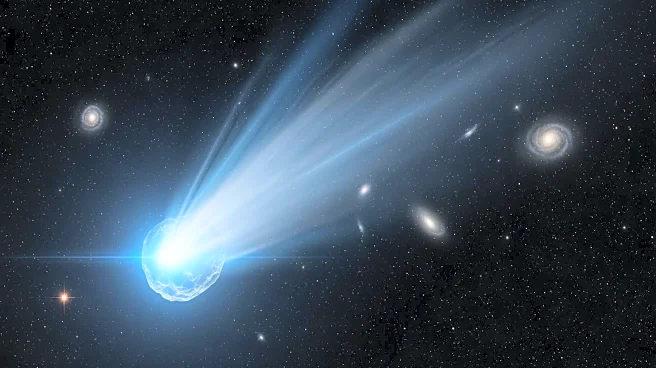
Larry Denneau, a senior software engineer and astronomer at the University of Hawaii's Institute for Astronomy, discovered an interstellar comet named 3I/ATLAS. This discovery was made using the Asteroid Terrestrial-impact Last Alert System (ATLAS), a network
of telescopes designed to detect near-Earth asteroids. The comet, classified by the Minor Planets Center, is only the third-known interstellar object observed passing through our solar system, following 1I/'Oumuamua and 2I/Borisov. Unlike typical comets, interstellar objects are not gravitationally bound to the sun and originate from other stars. Denneau's discovery was initially unremarkable but gained significance as follow-up observations confirmed its unusual trajectory, indicating it was not bound to the solar system.
Why It's Important?
The discovery of 3I/ATLAS is significant as it provides a rare opportunity to study material from outside our solar system. Interstellar objects like 3I/ATLAS offer insights into the composition and dynamics of other star systems, which can enhance our understanding of the universe. The ability to detect such objects also demonstrates the effectiveness of modern astronomical software and technology in identifying and tracking celestial bodies. This discovery underscores the importance of continued investment in astronomical research and technology to further explore and understand the cosmos.
What's Next?
Following the discovery of 3I/ATLAS, astronomers will likely conduct further observations to gather more data on its composition and trajectory. This could involve using various telescopes worldwide to track its path and analyze its properties. The findings could contribute to models of interstellar object behavior and inform future searches for similar objects. Additionally, the success of the ATLAS system in detecting 3I/ATLAS may lead to enhancements in detection technology and methodologies, potentially increasing the frequency of such discoveries.