
What's Happening?
Archaeologists have uncovered evidence of Ice Age humans in Ukraine constructing shelters using mammoth bones. The discovery was made near the village of Mezhyrich, approximately 70 miles southeast of Kyiv.
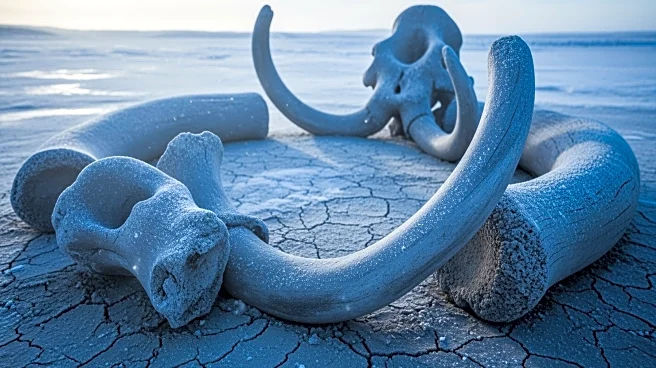
These structures date back to around 18,000 years ago, just after the Last Glacial Maximum, the coldest part of the last Ice Age. The shelters were built using mammoth skulls and large bones set vertically into the ground, forming a foundation. A wooden framework, along with hides or birch bark, likely covered the shelters, with tusks and large flat bones used as weights and wind protection. The site was initially excavated between 1966 and 1974, but recent studies have provided more precise dating, suggesting the largest structure was used between 18,323 and 17,839 years ago. These shelters were practical solutions for survival rather than permanent settlements, with each likely housing five to seven people.
Why It's Important?
This discovery provides significant insights into how Ice Age humans adapted to extreme climates. The use of mammoth bones for constructing shelters highlights the resourcefulness and ingenuity of these early humans in utilizing available materials for survival. Understanding these ancient practices can offer valuable perspectives on human resilience and adaptation. The findings also contribute to the broader understanding of human migration and settlement patterns during the Ice Age, offering clues about how communities thrived in harsh environments. This research underscores the importance of archaeological studies in uncovering human history and evolution.
What's Next?
Further research is needed to obtain more radiocarbon dates from the site to better understand the timeline of its use. Additional studies could explore the social and cultural aspects of the communities that built these shelters, providing a more comprehensive picture of their way of life. Continued excavation and analysis may reveal more about the construction techniques and materials used, as well as the daily activities and survival strategies of these Ice Age humans. Collaboration with international researchers could enhance the understanding of similar sites across Europe.
Beyond the Headlines
The use of mammoth bones in construction raises interesting questions about the relationship between humans and megafauna during the Ice Age. It suggests a complex interaction where humans not only hunted these large animals but also repurposed their remains for shelter. This practice reflects a deep understanding of their environment and the resources it provided. The study of such ancient practices can inform modern discussions on sustainability and resource management, highlighting the long history of human innovation in the face of environmental challenges.