


What's Happening?
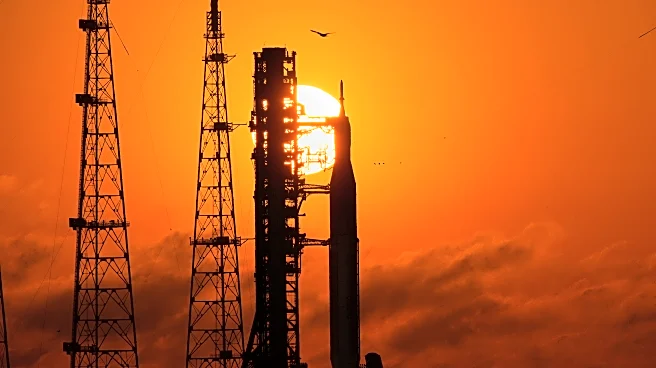
NASA is preparing to launch Artemis 2, the first crewed mission to the Moon in over 50 years. Scheduled for April 1, 2026, the mission will lift off from Kennedy Space Center in Florida. The crew includes Commander Reid Wiseman, Pilot Victor Glover, Mission
Specialist Christina Koch, and Canadian Space Agency's Jeremy Hansen. The mission aims to test the Orion spacecraft's life-support systems and conduct various scientific experiments, including deploying international CubeSats. The mission will follow a free-return trajectory around the Moon, allowing the spacecraft to return safely even if the main engine fails.
Why It's Important?
Artemis 2 represents a significant milestone in NASA's efforts to return humans to the Moon and eventually establish a sustainable presence there. The mission's success could pave the way for future lunar exploration and potential Mars missions. It also demonstrates international collaboration in space exploration, with CubeSats from Germany, South Korea, Saudi Arabia, and Argentina. The mission's outcomes could influence future space policy and funding, as well as inspire technological advancements in space travel and exploration.
What's Next?
Following the Artemis 2 mission, NASA plans to continue its Artemis program with subsequent missions aimed at landing astronauts on the lunar surface. The success of Artemis 2 will be crucial in building momentum and securing support for these future missions. Additionally, the data collected from the mission will help refine technologies and strategies for long-duration space travel, which is essential for future Mars missions.