








What's Happening?
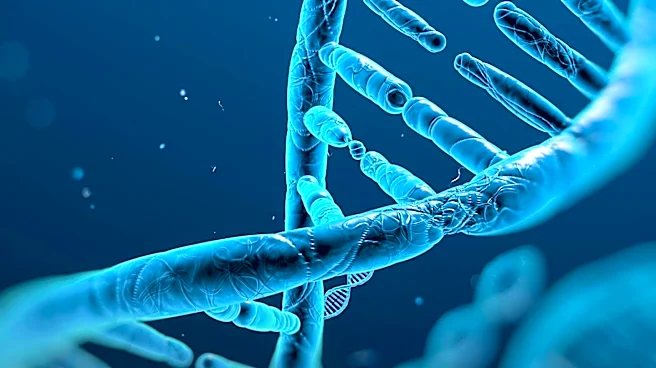
Researchers at UC Berkeley have developed a new technique to identify regions of DNA in modern humans that were inherited from two unknown ancestors, referred to as 'ghost' and 'super-archaic' ancestors. This discovery was made possible by analyzing hundreds
of genomes from present-day humans to uncover ancient genealogical relationships. The 'ghost' ancestor interbred with modern humans in Africa over 50,000 years ago, contributing approximately 1% of the DNA found in modern humans. The 'super-archaic' ancestor, a lineage dating back 1.8 million years, interbred with Denisovans in Eurasia, and some of this DNA was passed to modern humans through subsequent interbreeding. The findings suggest that early modern humans lived alongside and interbred with various hominin groups, creating a complex web of genetic connections.
Why It's Important?
This research provides significant insights into human evolution, challenging the traditional view of a linear evolutionary tree and suggesting a more interconnected history of human populations. The identification of DNA from unknown ancestors highlights the complexity of human ancestry and the pervasive nature of interbreeding among different hominin groups. These findings could have implications for understanding genetic diversity and adaptation in modern humans, particularly in areas related to immunity and metabolic functions. The study also opens up possibilities for further research into other extinct hominin lineages and their contributions to the human genome.
What's Next?
The researchers plan to continue using their technique, TRACE, to explore additional lineages in human DNA as genome databases expand. This could lead to the discovery of more unknown ancestors and provide a deeper understanding of human evolutionary history. The team also hopes to apply TRACE to other species, potentially uncovering different patterns across the tree of life. As more Denisovan genomes are sequenced, and protein sequences from Homo erectus fossils are analyzed, the identity of the super-archaic ancestor may become clearer.
Beyond the Headlines
The study raises ethical and cultural questions about the definition of human identity and ancestry. As genetic research continues to uncover complex interbreeding histories, it challenges the notion of distinct human populations and may influence discussions on race and ethnicity. Additionally, the findings could impact fields such as anthropology and archaeology, prompting a reevaluation of historical narratives about human migration and interaction.