





What's Happening?
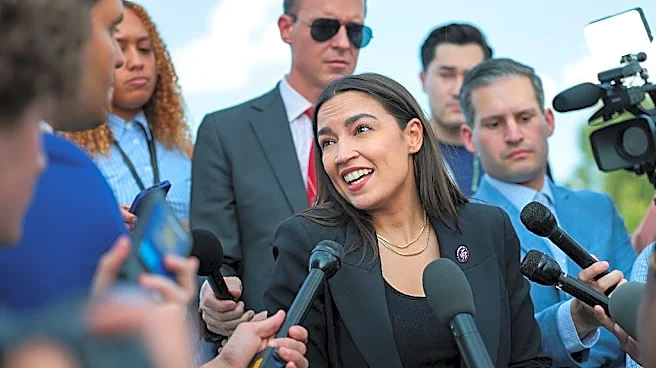
Democrat Representative Alexandria Ocasio-Cortez recently stated in an interview with ABC that a political ally described 'woke 1.0' as 'crazy.' This comment has generated varied interpretations among political observers. Some on the left view it as a strategic
move by Ocasio-Cortez to distance herself from perceived excesses of earlier progressive activism, while others see it as a step towards greater moderation without abandoning fundamental principles. There is a general sentiment that 'woke 1.0' either holds little meaning or, if it does, is largely positive, with any negative aspects attributed to the pursuit of a better world. The discussion acknowledges that if there were instances of 'houndings, cancellations, excessive limitations on free speech, [or] unrealistic political demands,' these were considered part of the effort to create a more just society.
Why It's Important?
Representative Ocasio-Cortez's remark is significant because it reflects an internal debate within progressive movements regarding the efficacy and consequences of past activist tactics. The acknowledgment of 'woke 1.0' being 'crazy' suggests a potential re-evaluation of strategies that may have led to 'cancellations' or 'excessive limitations on free speech.' This introspection could influence future progressive activism, potentially leading to more nuanced approaches that prioritize broader coalition-building and less confrontational methods. For the Democratic Party, this discussion is crucial as it navigates its relationship with its progressive wing and seeks to appeal to a wider electorate. The way this debate unfolds could impact the party's messaging, policy priorities, and overall public perception, especially concerning issues of social justice and cultural change. It also highlights the ongoing tension between radical activism and mainstream political viability.
What's Next?
The ongoing discussion surrounding 'woke 1.0' and its perceived excesses is likely to continue shaping the discourse within progressive circles and the Democratic Party. This could lead to further public statements from political figures and activists, either defending past tactics or advocating for new approaches. There may be a push for greater self-reflection and accountability within progressive movements, potentially resulting in a more refined understanding of effective advocacy. This internal debate could also influence how progressive policies are framed and presented to the public, with an emphasis on broader appeal and less divisive rhetoric. The outcome of this re-evaluation could determine the future direction of progressive activism and its impact on U.S. politics, particularly in upcoming election cycles.
Beyond the Headlines
The debate initiated by Representative Ocasio-Cortez's comment delves into the deeper ethical and strategic considerations of social and political movements. It raises questions about the balance between achieving social justice goals and maintaining civil discourse, free speech, and due process. The concept of 'woke 1.0' as 'crazy' implicitly acknowledges that some past actions, even if well-intentioned, may have been counterproductive or caused undue harm. This introspection is vital for the long-term health and effectiveness of any movement, as it allows for learning from mistakes and adapting strategies. The discussion also touches upon the challenge of distinguishing between legitimate criticism and what some perceive as 'whataboutism' or attempts to deflect from broader societal issues. Ultimately, this internal dialogue could lead to a more mature and resilient progressive movement, capable of achieving its objectives while upholding core democratic values.