




What's Happening?
New research suggests that frequent star collisions in the early universe could explain the rapid formation of supermassive black holes and the mysterious 'Little Red Dots' observed by the James Webb Space Telescope (JWST). Simulations conducted by a team
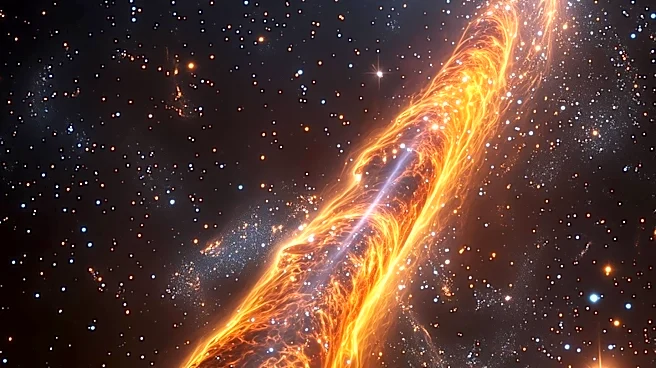
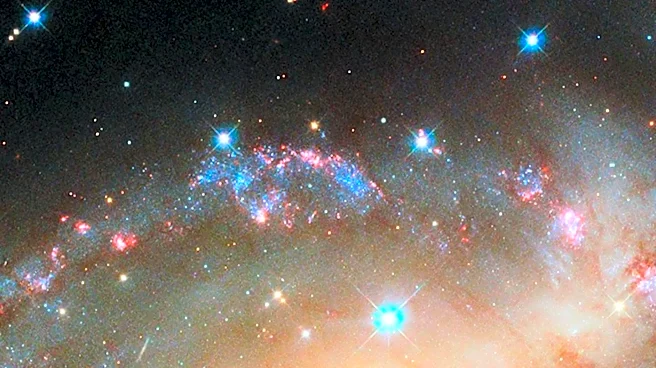
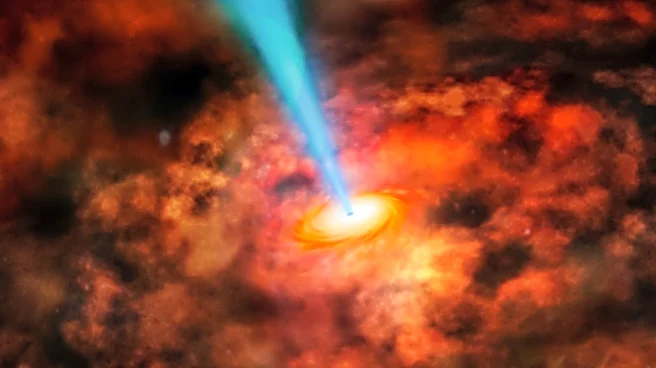
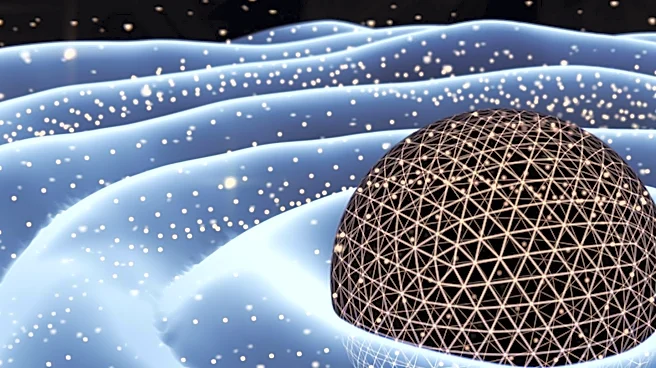
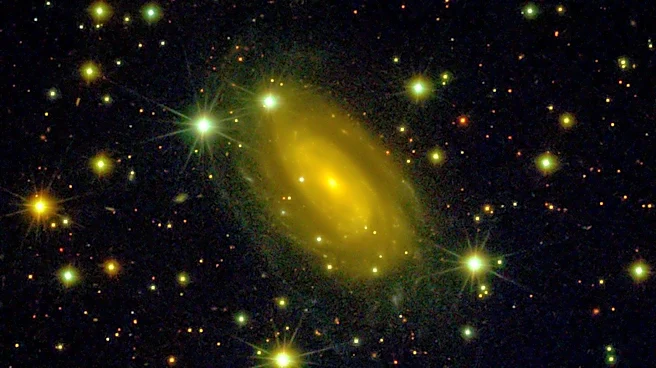
of scientists indicate that stellar systems in the early cosmos were densely packed, leading to numerous stellar impacts. While high-speed collisions would destroy stars, slower mergers could create single, over-massive stars. These colossal stars, upon collapsing, would form larger-than-usual black holes, potentially serving as the 'seeds' for the first supermassive black holes. This mechanism addresses the puzzle of how supermassive black holes achieved their immense size within the first billion years of the universe, a timeframe previously thought insufficient for their growth through feeding and merging processes. The research also proposes that 'Little Red Dots,' compact objects seen in the early universe that disappeared after about 2 billion years, might be dense star clusters undergoing repeated stellar collisions, eventually forming intermediate-mass black holes.
Why It's Important?
This research significantly advances our understanding of the early universe and the fundamental processes that shaped galactic evolution. The existence of supermassive black holes so early in cosmic history has been a long-standing enigma for astronomers. By providing a plausible mechanism for their rapid formation through stellar collisions, the study helps to fill a critical gap in cosmological models. Furthermore, offering an explanation for the 'Little Red Dots' — objects whose nature has been a subject of debate since their discovery by the JWST — provides a more coherent picture of the chaotic and dynamic conditions prevalent in the nascent universe. Understanding these early processes is crucial for comprehending the subsequent development of galaxies, including our own Milky Way, and the distribution of matter and energy in the cosmos. This insight could influence future astronomical observations and theoretical frameworks, guiding the search for more evidence of these ancient stellar interactions.
What's Next?
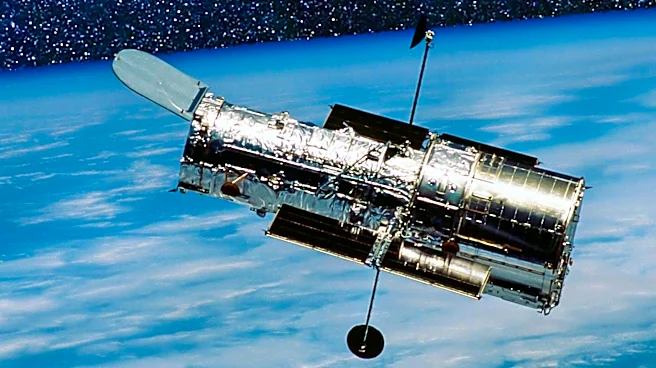
Future astronomical observations, particularly with advanced telescopes like the JWST, will be crucial to further validate these simulations and theories. Astronomers will likely focus on identifying more 'Little Red Dots' and studying their properties in greater detail to confirm if they indeed harbor rapidly growing black holes or are dense star clusters. Continued analysis of the early universe's composition and dynamics will also be essential to refine the models of stellar collision rates and their outcomes. The research team's findings, published in The Astrophysical Journal, will likely spur further theoretical work and observational campaigns aimed at uncovering more evidence of these ancient stellar mergers and their role in the formation of the universe's most massive objects. The insights gained could also inform the design of future space missions and instruments tailored to probe the very first epochs of cosmic history.
Beyond the Headlines
The implications of this research extend beyond astrophysics, touching upon the very origins of structure in the universe. If stellar collisions were indeed a primary driver for the formation of early black hole seeds, it suggests a more violent and dynamic early cosmos than previously imagined. This challenges the traditional view of black hole formation primarily through the collapse of individual massive stars and subsequent accretion. The concept of 'intermediate-mass black holes' as crucial stepping stones to supermassive black holes gains significant traction, potentially resolving a long-standing theoretical gap. Moreover, the transient nature of 'Little Red Dots' highlights how different the universe's conditions were billions of years ago, with chaotic, dense regions giving way to the more ordered galactic structures we observe today. This shift underscores the profound evolutionary changes the cosmos has undergone, driven by fundamental physical processes that are still being unraveled.