






What's Happening?
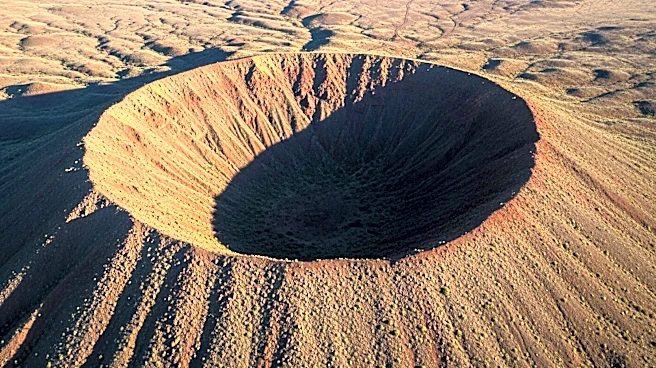
Recent research indicates that the Zhamanshin impact crater in Kazakhstan, previously believed to be less impactful, may be significantly larger and more destructive than earlier estimates suggested. The crater, formed approximately 900,000 years ago,
was initially thought to measure about 14 kilometers in diameter. However, new findings propose that it could be as large as 26.5 kilometers, suggesting a much higher impact energy. This research, led by James Garvin from NASA's Goddard Space Flight Center, utilized advanced remote-sensing techniques like LiDAR to detect previously unseen outer rings of the crater. The study, published in the Planetary Science Journal, posits that the impact's energy could have been over 240,000 megatons, potentially causing significant environmental changes during the Pleistocene era.
Why It's Important?
The implications of this research are profound, as it challenges previous understandings of the Zhamanshin impact's effects on Earth's climate and biological systems. If the crater is indeed larger, the impact could have contributed to significant climate changes and possibly influenced the evolution of life on Earth during the Pleistocene. This period was marked by notable shifts in glacial behavior, and the impact may have played a role in these changes. Understanding the true scale of such impacts is crucial for comprehending Earth's geological and biological history, as well as for assessing potential future threats from similar events.
What's Next?
Further research is needed to confirm these findings and explore their implications. Scientists may conduct additional geophysical surveys and analyze climate records from the time of the impact to uncover any biological effects. This research could also extend to studying similar impact events on other planets, such as Mars, to enhance our understanding of planetary impacts in an astrobiological context. These efforts align with NASA's exploration priorities, potentially informing future missions to the Moon and Mars.
Beyond the Headlines
The study of the Zhamanshin crater highlights the challenges in accurately measuring ancient impact sites due to erosion and other geological processes. The findings underscore the importance of using advanced technologies to reassess historical data, which can lead to new insights into Earth's past. Additionally, understanding the full impact of such events can inform planetary protection strategies and help prepare for potential future impacts.