








What's Happening?
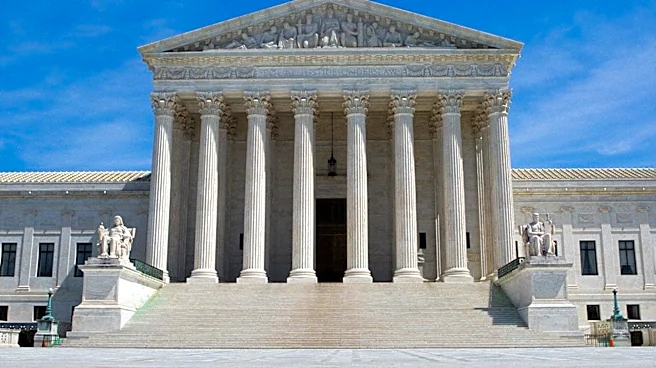
The U.S. Supreme Court has issued a significant ruling in the case of Monsanto Co. v. Durnell, which extends the principle of federal preemption beyond pesticides to potentially affect various industries. The court ruled 7-2 that the Federal Insecticide,
Fungicide, and Rodenticide Act (FIFRA) preempts state failure-to-warn claims that challenge labeling approved by the Environmental Protection Agency (EPA). Under FIFRA, the EPA evaluates pesticides and approves labels that it deems necessary to protect health and the environment. The ruling emphasized that states cannot impose additional labeling requirements beyond those federally mandated. This decision builds on the court's 2008 ruling in Riegel v. Medtronic, which established that federal premarket approval of medical devices preempts state tort claims. The Durnell decision could influence industries governed by similar federal statutes, such as the Medical Device Amendments and the Federal Meat Inspection Act.
Why It's Important?
This ruling is pivotal as it reinforces the federal government's authority over state regulations in industries with specific federal product requirements. By extending preemption principles, the decision could limit the ability of states to impose additional safety or labeling requirements, thereby affecting consumer protection and state-level regulatory power. Industries such as cosmetics, over-the-counter drugs, and food products may see significant impacts, as federal standards could override state laws. This could streamline national markets by ensuring uniform labeling and safety standards, but it may also reduce states' ability to address local concerns or emerging health risks. Businesses in these sectors might benefit from reduced liability and regulatory complexity, while consumer advocacy groups could face challenges in pushing for stricter safety measures.
What's Next?
Industries affected by this ruling are likely to engage more actively in the federal rulemaking process to influence the development of regulations that could preempt state laws. Companies may also need to ensure compliance with evolving federal standards to avoid liability. Legal experts suggest that future claims might need to align closely with federal requirements to survive preemption challenges. The decision may prompt legislative efforts to clarify or adjust the balance between federal and state regulatory powers, particularly in areas where consumer safety is a concern.
Beyond the Headlines
The ruling highlights a broader legal and regulatory trend towards centralization of authority at the federal level, which could have long-term implications for state sovereignty and consumer rights. The decision may also influence how courts interpret preemption in other contexts, potentially affecting a wide range of industries. Legal scholars and policymakers might debate the ethical and practical implications of limiting state powers in favor of federal uniformity, especially in sectors where rapid technological or scientific advancements occur.