





What's Happening?
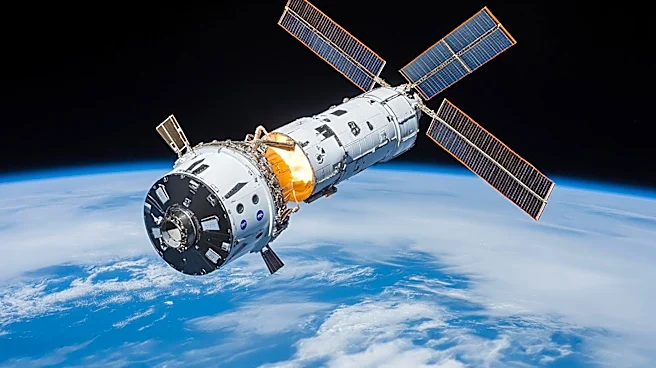
China's Tiangong Space Station is set to host its first international visitor this month, a Pakistani astronaut, marking a significant milestone in China's manned space program. The Pakistani national will be part of the Shenzhou-24 mission, which also
includes two Chinese astronauts, and is expected to spend a week aboard the orbital outpost. This joint mission stems from an agreement signed between the governments of China and Pakistan in February 2025. Two Pakistani Air Force pilots, Muhammad Zeeshan Ali and Khurram Daud, were selected after extensive training at the Astronaut Centre of China in Beijing. The launch will occur aboard a Long March 2F rocket from the Jiuquan Satellite Launch Center in the Gobi Desert. The Pakistani astronaut will serve as a payload specialist and return on the Shenzhou-23 spacecraft, while their Chinese counterparts will remain for six months, replacing the current Shenzhou-23 crew.
Why It's Important?
This mission signifies a deepening of space cooperation between China and Pakistan, building on a decades-long partnership that includes China launching Pakistan's first satellite in 1990. It also marks China's first joint mission with a foreign astronaut, underscoring its growing role in international space collaboration and its ambition to expand access to its Tiangong Space Station. For Pakistan, sending its first astronaut into space is a major national achievement, enhancing its scientific and technological prestige. This collaboration is part of a broader strategy by China to strengthen its space partnerships, which includes scientific experiments, visits by foreign astronauts, docking of foreign spacecraft, and potentially adding new modules built by partners to Tiangong. Pakistan's involvement in the China-led International Lunar Research Station (ILRS) program further highlights the strategic importance of this alliance, as China aims to land its nationals on the Moon before 2030.
What's Next?
The launch of the Shenzhou-24 mission, carrying the first Pakistani astronaut, is anticipated later this month, with an exact date and confirmation of the flier still pending. Following this mission, China is expected to continue expanding its international space cooperation, potentially inviting more foreign astronauts and partners to its Tiangong Space Station. This initiative could lead to increased scientific collaboration and technological exchange between China and other nations. The long-term implications include the potential for China to establish itself as a leading hub for international space activities, offering an alternative to existing collaborations centered around the International Space Station. The success of this mission will likely pave the way for further joint ventures, particularly within the framework of the International Lunar Research Station program, as China advances its lunar exploration goals.
Beyond the Headlines
This mission carries significant geopolitical implications, showcasing China's growing influence in space and its ability to forge strong international partnerships independent of traditional space powers. By hosting a Pakistani astronaut, China is demonstrating its commitment to multilateral space cooperation, potentially attracting other nations to its space programs. This move could reshape the global landscape of space exploration, fostering a more multipolar environment where multiple nations lead significant space initiatives. The mission also highlights the strategic alignment between China and Pakistan, extending their cooperation into the critical domain of space technology. This collaboration could have broader impacts on scientific development, technological transfer, and diplomatic relations, as space becomes an increasingly important arena for international prestige and strategic advantage.