






What's Happening?
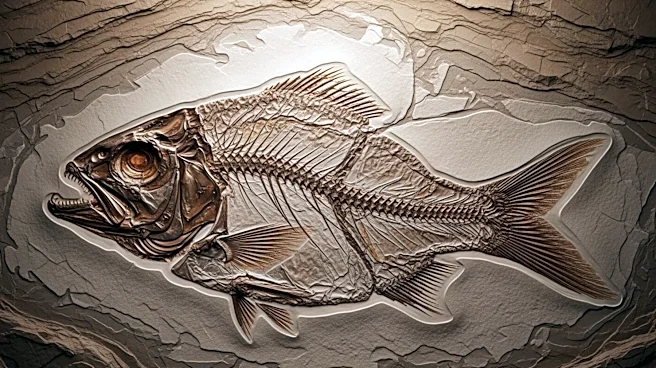
Researchers from the Chinese Academy of Sciences have discovered a 436-million-year-old bony fish fossil, Eosteus chongqingensis, in South China. This fossil is the oldest near-complete articulated bony fish ever found, providing new insights into vertebrate
evolution. The discovery fills a significant gap in the fossil record from the Silurian period, a time when bony fish were evolving into distinct lineages. E. chongqingensis exhibits a mix of traits seen in both ray-finned and lobe-finned fish, suggesting that these features emerged earlier than previously thought. This finding challenges existing theories about the timeline of vertebrate evolution and highlights the complexity of early fish development.
Why It's Important?
The discovery of Eosteus chongqingensis is crucial for understanding the evolutionary history of vertebrates, including humans. By providing evidence of early bony fish traits, this fossil helps clarify the timeline and processes involved in the diversification of vertebrates. The research offers a more detailed picture of how ancient fish adapted to their environments, which can inform studies on evolutionary biology and the development of modern species. Additionally, the findings underscore the importance of preserving fossil sites and continuing paleontological research to uncover more about Earth's biological past.
What's Next?
The research team plans to conduct further studies on the fossil to explore its anatomical features in greater detail. This may involve advanced imaging techniques and comparative analysis with other fossils from the same period. The findings could lead to revisions in the classification of early vertebrates and provide new insights into the evolutionary pathways that led to the diversity of life we see today. Continued exploration of fossil sites in China and elsewhere may yield additional discoveries that further illuminate the history of vertebrate evolution.