
What's Happening?
NASA's Perseverance rover, part of the Mars 2020 mission, is currently exploring new terrain beyond the Jezero crater rim, specifically an area known as 'Lac de Charmes.' This region is significant for
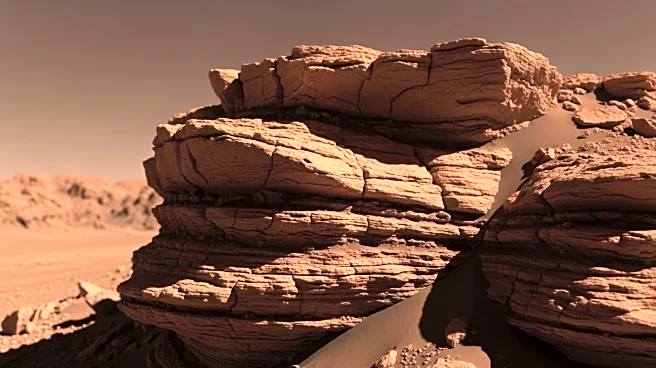
its potential to reveal pre-Jezero ancient bedrock and impactites, which are rocks affected by the impact event that created the Jezero crater. The rover's journey has been marked by the discovery of a large potential impactite, named 'Hyha,' visible even from orbit. The exploration of these ancient rocks is expected to provide insights into the geological history of Mars, particularly the processes involved in the formation of complex craters like Jezero. The rover's mission is to collect samples that could offer clues about the planet's past, including the possibility of ancient life.
Why It's Important?
The exploration of Mars by the Perseverance rover is crucial for understanding the planet's geological history and assessing its potential to have supported life. The discovery of ancient rocks and impactites can provide valuable information about the conditions on Mars billions of years ago. This research is not only significant for planetary science but also for future human exploration. By understanding the geological processes and history of Mars, scientists can better prepare for potential human missions to the planet. The findings from Perseverance could also inform the search for life beyond Earth, as the conditions that preserved these ancient rocks might have also supported microbial life.
What's Next?
As Perseverance continues its mission, it will focus on collecting and analyzing rock samples from the Lac de Charmes area. These samples will be crucial for understanding the differences between the pre-Jezero bedrock and the impactites. The rover's findings will be shared with the scientific community, contributing to ongoing research about Mars' geological history. Future missions may build on Perseverance's discoveries, potentially leading to more targeted exploration of areas with high scientific interest. The rover's continued operation will also test its durability and the effectiveness of its scientific instruments in harsh Martian conditions.